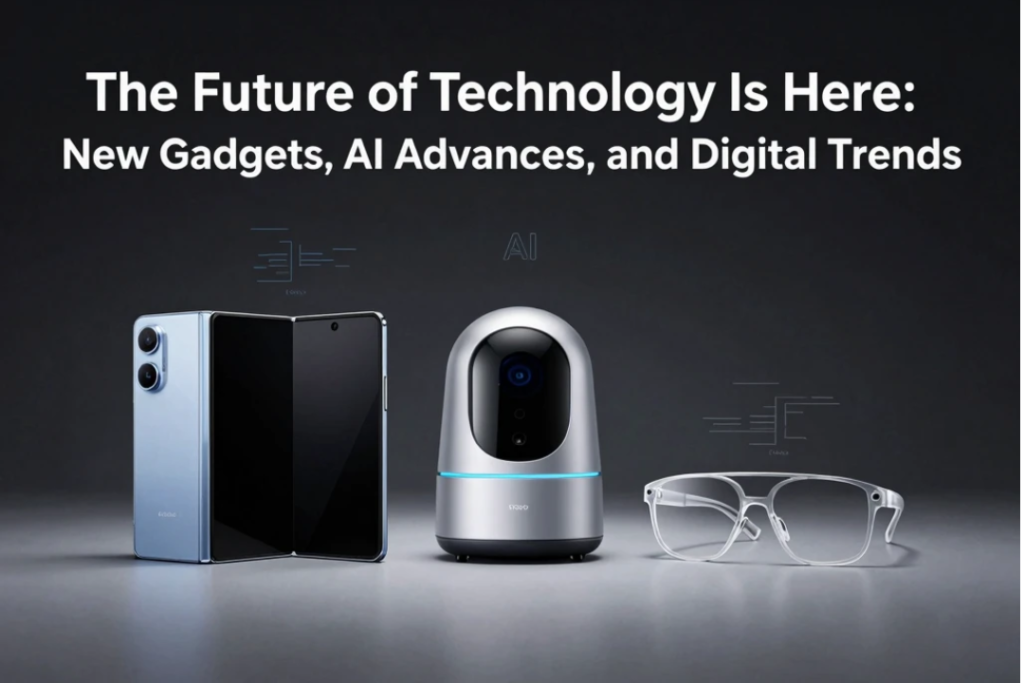
The future of technology is no longer something that exists only in science-fiction movies or research laboratories. Many technologies that once seemed futuristic are already becoming part of everyday life.
Artificial intelligence is being integrated into smartphones and computers. Smartwatches can monitor a wide range of health and fitness information. Connected homes can automate everyday tasks, while new gadgets are becoming smaller, smarter, and more personalized.
At the same time, robotics, spatial computing, advanced batteries, cybersecurity, and next-generation connectivity are creating new possibilities for consumers and businesses.
The biggest change is not necessarily one revolutionary gadget. Instead, multiple technologies are developing together and creating a more connected digital ecosystem.
So, what does the future of technology look like, and which developments should consumers pay attention to?
1. Artificial Intelligence Is Becoming an Everyday Technology
Artificial intelligence is at the center of many current technology developments.
AI is no longer limited to research laboratories or specialized business applications. It is becoming part of smartphones, laptops, search engines, cameras, productivity software, customer service platforms, and smart home systems.
People can use AI to:
- Write and edit content
- Summarize information
- Translate languages
- Analyze data
- Improve photographs
- Generate ideas
- Organize tasks
- Assist with research
- Automate repetitive work
The next stage of AI development is likely to focus less on novelty and more on practical usefulness.
Instead of asking users to open a separate AI application, technology companies are increasingly integrating AI directly into products people already use.
2. AI Agents Could Change How We Work
One of the most interesting AI developments is the rise of AI agents.
A traditional software application usually requires a person to perform each step manually. An AI agent can potentially handle multiple steps based on a broader objective.
For example, an AI system could research information, organize the results, analyze data, prepare a summary, and create a draft.
Businesses are exploring AI agents for customer service, research, software development, marketing, administration, and productivity.
However, these systems still require appropriate permissions and human supervision, especially when dealing with sensitive information or important decisions.
3. Smartphones Are Becoming AI-Powered Devices
Smartphones remain one of the most important personal technology products.
The future smartphone is increasingly defined by the combination of hardware and AI software.
AI can improve photography, voice interaction, translation, search, security, battery management, and personalization.
For example, computational photography can use advanced processing to improve images taken in difficult lighting conditions.
AI-powered editing can also help users remove unwanted objects, improve portraits, enhance images, and organize photographs.
This means future smartphone upgrades may focus as much on intelligent features as on processors, cameras, and displays.
4. Foldable Phones Continue to Evolve
Foldable smartphones represent another important development.
Instead of using a conventional fixed display, foldable devices allow manufacturers to provide larger screens while keeping the device relatively compact when folded.
Book-style foldables can provide more screen space for multitasking, while flip-style models can focus on portability.
However, challenges remain.
Manufacturers still need to improve durability, battery efficiency, thickness, price, and long-term reliability.
If these areas continue to improve, foldable technology could become increasingly common.
5. AI PCs Are Redefining Personal Computers
Artificial intelligence is also changing laptops and desktop computers.
AI PCs include hardware designed to handle certain AI workloads efficiently.
This can support features such as:
- AI assistants
- Video-call enhancements
- Noise reduction
- Content creation
- Image editing
- Security functions
- Local AI processing
- Productivity tools
One important development is on-device AI.
Certain tasks can be performed locally rather than sending every request to a cloud server. This can potentially improve responsiveness and provide privacy benefits for some applications.
6. Smartwatches and Wearables Become More Intelligent
Wearable technology continues to develop rapidly.
Smartwatches and fitness trackers can provide information about activity, workouts, sleep, heart rate, and other wellness-related measurements depending on the device.
Smart rings are also becoming an interesting category because they can provide tracking features in a smaller form factor.
The future of wearables is likely to focus on turning collected information into useful insights.
AI could help users understand patterns rather than simply presenting large amounts of raw data.
These devices can support wellness and fitness, but health-related measurements should not be considered a replacement for professional medical advice.
7. Smart Glasses Could Become the Next Major Gadget
Smart glasses are one of the most interesting possibilities for the future of personal technology.
Instead of requiring users to look down at a smartphone, smart glasses could potentially provide information directly within the user’s field of view.
Future applications could include:
- Navigation
- Live translation
- Notifications
- Voice assistance
- Photography
- Hands-free communication
- Contextual information
The major challenges include battery life, comfort, privacy, cost, and social acceptance.
If manufacturers can solve these problems, smart glasses could become a major new technology category.
8. Robotics Is Moving Into Everyday Environments
Robotics is expanding beyond traditional industrial applications.
Robots are being developed for warehouses, logistics, agriculture, healthcare, cleaning, delivery, and other environments.
Humanoid robots are particularly interesting because their physical design is intended to work in environments designed for humans.
AI can help robots understand instructions, identify objects, navigate spaces, and adapt to changing situations.
However, widespread use will depend on cost, safety, reliability, and practical usefulness.
9. Smart Homes Are Becoming More Connected
Smart home technology is moving toward greater integration.
Instead of controlling individual devices separately, users increasingly want lights, cameras, locks, thermostats, appliances, speakers, and sensors to work together.
AI can potentially make these systems more useful by recognizing patterns and automating routines.
For example, a smart home could adjust lighting or temperature based on activity and preferences.
However, connected homes also create privacy and cybersecurity concerns.
Consumers should choose reputable devices, keep software updated, and understand what data their smart products collect.
10. Battery Technology Will Shape Future Gadgets
Battery technology is one of the most important factors affecting portable technology.
Smartphones, laptops, smartwatches, wireless earbuds, electric vehicles, and portable power systems all depend on battery performance.
Future improvements may focus on:
- Higher energy density
- Faster charging
- Longer lifespan
- Improved safety
- Better thermal management
- More efficient manufacturing
Better batteries could allow future devices to operate longer without becoming significantly larger.
This could have a major impact on both consumer electronics and electric transportation.
11. Electric Vehicles Become Smarter
Electric vehicles are increasingly becoming software-driven products.
Modern EVs can include advanced driver assistance, connected navigation, smart charging, battery management, digital entertainment, and software updates.
Future vehicles could become even more connected to homes, mobile devices, charging networks, and cloud services.
However, consumers should distinguish between driver-assistance systems and fully autonomous driving. Different technologies provide different levels of automation and require different levels of human supervision.
12. Spatial Computing Creates New Digital Experiences
Spatial computing is changing the way digital content can be experienced.
Instead of interacting only with flat displays, spatial computing can place digital objects into three-dimensional environments.
Potential applications include:
- Gaming
- Education
- Professional training
- Engineering
- Design
- Collaboration
- Entertainment
- Visualization
The technology still faces challenges involving hardware cost, comfort, battery life, and the availability of useful applications.
Nevertheless, spatial computing could become an important part of future digital experiences.
13. Cybersecurity Becomes Even More Important
As technology becomes more connected, cybersecurity becomes increasingly important.
AI is being used to identify suspicious activity, analyze security data, and help security teams respond to threats.
Unfortunately, attackers can also use AI and automation to create more convincing scams and attacks.
Consumers and businesses therefore need stronger security practices.
Using multi-factor authentication, keeping software updated, avoiding suspicious links, protecting passwords, and maintaining backups can significantly improve digital security.
14. Cloud and Edge Computing Work Together
Cloud computing has transformed modern digital services, but not every task needs to be processed far away in a data center.
Edge computing brings certain processing capabilities closer to users and devices.
This can help reduce latency and improve responsiveness for applications such as smart cameras, connected vehicles, industrial systems, gaming, and AI-powered devices.
Future technology will likely combine cloud computing, edge processing, and local device intelligence.
15. Quantum Computing Remains a Long-Term Innovation
Quantum computing is another technology worth watching.
Quantum computers are designed to approach certain computational problems differently from conventional computers.
Potential applications include scientific research, drug discovery, materials science, optimization, and cryptography.
Quantum computers are not expected to replace ordinary smartphones or laptops. Instead, their potential lies in specialized problems.
The technology remains at an early stage, but continued progress could have significant long-term effects.
16. Digital Health Is Becoming More Connected
Technology is increasingly being used to support healthcare and wellness.
Wearable devices, telehealth platforms, remote monitoring systems, and digital health applications can help collect and organize information.
AI can also assist with certain administrative and analytical tasks.
The key challenge is ensuring accuracy, privacy, security, and responsible use.
Health technology should support professional healthcare rather than encourage people to rely entirely on automated systems.
17. Sustainable Technology Is Gaining Momentum
The future of technology is also connected to sustainability.
Manufacturers are increasingly considering energy efficiency, product longevity, repairability, recycling, and resource use.
The growth of AI and cloud computing is also increasing interest in the energy requirements of data centers.
Future technology may therefore be evaluated not only by performance and features but also by its environmental impact and efficiency.
18. Software Is Becoming More Personalized
Modern software is becoming increasingly capable of adapting to individual users.
AI can help applications understand preferences, organize information, recommend content, and automate repetitive actions.
Personalization can make software more convenient, but it also raises important questions about privacy.
Users should understand what data applications collect and how that information is used.
How These Technologies Will Work Together
The most important part of the future may be the combination of technologies.
Imagine a connected environment where an AI assistant works across a smartphone, laptop, smartwatch, smart glasses, and smart home.
Your smartwatch could provide activity information. Your phone could manage communication. Your laptop could help with work. Smart glasses could provide hands-free information. Your home could automatically adjust its environment.
Individually, these technologies may seem like small improvements.
Together, they could create a completely different digital experience.
Future Technology at a Glance
| Technology | Potential Impact |
|---|---|
| Artificial Intelligence | Smarter software and services |
| AI Agents | Automated multi-step workflows |
| AI Smartphones | Intelligent mobile experiences |
| AI PCs | Smarter personal computing |
| Foldable Devices | Flexible screen experiences |
| Smart Wearables | Personalized wellness tracking |
| Smart Glasses | Hands-free digital interaction |
| Robotics | Automation in physical environments |
| Smart Homes | Connected household automation |
| Advanced Batteries | Longer-lasting devices |
| Electric Vehicles | Smarter transportation |
| Spatial Computing | Immersive digital experiences |
| Quantum Computing | Specialized advanced computing |
| Edge Computing | Faster local processing |
| Cybersecurity AI | Better digital protection |
What Consumers Should Expect
The future of technology will not arrive as one single event.
Instead, it will appear gradually through software updates, new devices, improved services, and increasingly connected ecosystems.
Some innovations will become mainstream quickly, while others may remain niche or experimental for years.
Consumers should therefore focus on practical value rather than simply buying the newest product.
Before upgrading, consider performance, battery life, software support, privacy, security, compatibility, repairability, and total cost.
Final Thoughts
The future of technology is here in many ways.
Artificial intelligence is becoming part of everyday software and hardware. New gadgets are becoming more connected, wearable technology is becoming smarter, robotics is expanding into new environments, and software is increasingly automated and personalized.
At the same time, technologies such as advanced batteries, spatial computing, quantum computing, edge computing, and smart transportation are laying the groundwork for the next generation of digital products.
The most exciting development may not be a single device. It may be the way all these technologies work together.
As technology becomes more intelligent and connected, consumers will have more opportunities to save time, improve productivity, communicate more easily, and automate everyday tasks.
The challenge will be making sure that convenience is balanced with privacy, security, affordability, reliability, and responsible innovation.
The future is arriving one innovation at a time—and many of those innovations are already in our hands.
Frequently Asked Questions
What is the future of technology?
The future of technology includes increasingly intelligent, connected, automated, and personalized devices and services. Major areas include AI, robotics, wearables, smart homes, advanced batteries, spatial computing, and next-generation computing.
What are the biggest technology trends in 2026?
Major trends include AI agents, AI-powered smartphones and PCs, smart wearables, smart glasses, robotics, cybersecurity, smart homes, electric vehicles, advanced batteries, and spatial computing.
Will AI replace traditional software?
AI is more likely to become integrated into traditional software than completely replace it. Many applications are adding AI features to improve productivity and automate repetitive tasks.
Are smart glasses the future?
Smart glasses have the potential to become an important personal technology category, particularly for hands-free navigation, communication, translation, and AI assistance. Their adoption will depend on price, comfort, battery life, privacy, and useful applications.
What technology will have the biggest impact?
Artificial intelligence is likely to remain one of the most influential technologies because it can be integrated into smartphones, computers, software, business systems, healthcare, transportation, and many other areas.
How can consumers prepare for future technology?
Consumers should focus on learning how new technology can solve real problems. When purchasing devices, consider long-term software support, security, privacy, compatibility, repairability, battery life, and overall value rather than simply choosing the newest product.