Introduction
Artificial intelligence has become an important part of our everyday lives. From virtual assistants and online shopping recommendations to healthcare systems and self-driving cars, AI technology is changing the way people work, communicate, and make decisions. Businesses are using AI to improve productivity, while individuals rely on intelligent tools to solve problems and find information more quickly. However, as AI becomes more powerful, questions about its safety, fairness, and impact on society are becoming increasingly important.
This is where Responsible AI comes into the picture. It refers to the development and use of artificial intelligence in ways that are fair, transparent, secure, and beneficial to people. The goal is not simply to create smarter machines but to ensure that these technologies respect human rights, protect personal information, and produce reliable results.
Responsible AI is no longer just a technical concern for developers. It is a shared responsibility involving businesses, governments, researchers, and everyday users. Understanding its principles can help organizations build public trust and make better decisions about the future of technology.
What Is Responsible AI?
Responsible AI is an approach to designing, developing, deploying, and managing artificial intelligence systems while considering their ethical, social, and legal consequences. It focuses on making sure that AI systems operate in ways that align with human values and minimize potential harm.
For example, imagine a company using an AI system to review job applications. If the system consistently rejects qualified candidates because of their gender, ethnicity, age, or another irrelevant characteristic, it creates an unfair hiring process. A responsible approach would involve checking the system for bias, evaluating its decisions, protecting applicants’ data, and allowing human reviewers to challenge questionable outcomes.
Similarly, a healthcare organization using AI to support medical decisions must consider accuracy, patient privacy, and professional oversight.
Responsible AI does not mean avoiding artificial intelligence altogether. Instead, it means using the technology thoughtfully, understanding its limitations, and taking appropriate steps to prevent harm.
Why Is Responsible AI Important?
The growing use of AI creates opportunities, but it also introduces risks that cannot be ignored. Responsible AI helps organizations benefit from technological progress without overlooking the people affected by automated decisions.
One major reason it matters is public trust. People are more likely to accept AI-powered services when they understand how their information is used and believe that decisions are made fairly. Trust becomes especially important when AI influences healthcare, education, employment, banking, or public services.
Another reason is risk reduction. AI systems can produce incorrect information, expose sensitive data, or make decisions based on misleading patterns. Identifying these problems early can prevent financial losses, legal disputes, and damage to an organization’s reputation.
Responsible AI also encourages long-term innovation. Companies that consider ethical issues during development are better positioned to identify weaknesses, improve their products, and respond to changing expectations.
Ultimately, technological progress should improve people’s lives rather than create unnecessary risks or deepen existing inequalities.
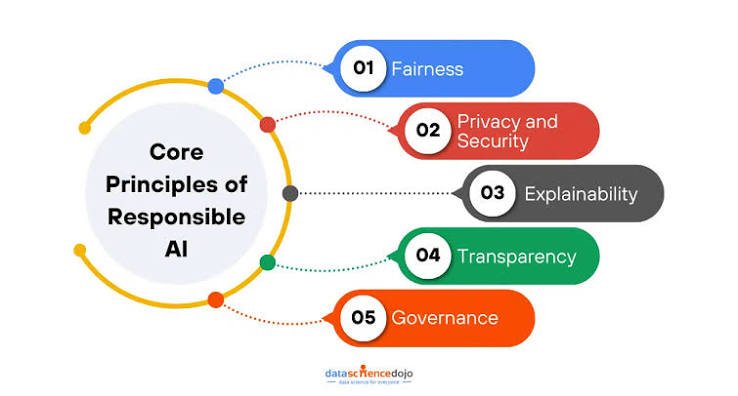
Key Principles of Responsible AI
Several principles help guide the responsible use of artificial intelligence. Although their implementation may vary depending on the industry and application, the following principles are widely recognized.
1. Fairness and Reducing Bias
AI systems learn patterns from data. If the information used to train a system contains historical discrimination or incomplete representation, the resulting technology may reproduce those problems.
Fairness means identifying and reducing unjustified differences in how people are treated by AI. Developers can examine training datasets, test system performance across different groups, and regularly evaluate real-world outcomes.
For instance, a lending system should not unfairly disadvantage applicants because of characteristics unrelated to their ability to repay a loan. Regular testing and appropriate human review can help identify potential discrimination.
2. Transparency and Explainability
People should have a reasonable understanding of when AI is being used and how important decisions are reached.
Transparency may involve informing users that they are interacting with an AI chatbot, explaining the purpose of an automated system, or describing the main factors behind a decision.
Explainability is particularly important when an AI system affects someone’s employment, finances, health, or access to essential services. Although some advanced models are difficult to interpret fully, organizations should provide meaningful explanations appropriate to the risks involved.
3. Privacy and Data Protection
AI systems often depend on large amounts of data, some of which may contain personal or sensitive information. Responsible AI requires organizations to collect only the information they genuinely need, protect it against unauthorized access, and use it for appropriate purposes.
Strong security practices, access controls, data encryption, and clear privacy policies can reduce risks. Organizations should also respect applicable data protection laws and avoid collecting personal information without a legitimate reason.
Protecting privacy is not only a legal obligation in many situations; it is also an essential part of maintaining user confidence.
4. Accountability and Human Oversight
Someone must be responsible for the way an AI system operates and the consequences of its decisions.
Accountability means assigning clear responsibilities for development, testing, deployment, monitoring, and responding to problems. It also means establishing procedures for reporting errors and correcting harmful outcomes.
Human oversight is especially valuable in high-impact situations. For example, AI can help doctors identify possible medical conditions, but qualified healthcare professionals should evaluate the evidence and make appropriate clinical decisions.
Human involvement should be meaningful rather than a simple formality. Reviewers need enough information, authority, and time to question an AI-generated recommendation.
5. Safety, Reliability, and Security
A responsible AI system should perform consistently under expected conditions and have safeguards against foreseeable failures.
This requires testing systems before release, monitoring their performance, checking for security vulnerabilities, and updating them when necessary. Developers should also consider how systems might behave when users provide unusual inputs or deliberately attempt to misuse them.
For generative AI, reliability includes recognizing that models may produce convincing but incorrect information. Users should verify important claims instead of assuming that every answer is accurate.
How Businesses Can Implement Responsible AI
Businesses do not need to wait for a major problem before taking responsible AI seriously. They can begin by establishing clear policies and building appropriate safeguards into their everyday operations.
First, organizations should identify where AI is being used and what decisions it influences. A tool that suggests blog topics presents different risks from a system that evaluates loan applications or helps prioritize medical treatment.
Next, companies should conduct risk assessments before introducing AI into important workflows. These assessments can examine possible bias, privacy concerns, security weaknesses, reliability issues, and the consequences of incorrect outputs.
Data quality is another important consideration. Businesses should check whether their training and evaluation data are relevant, sufficiently representative, and collected appropriately. Poor-quality data can undermine even sophisticated technology.
Organizations should also train employees to use AI responsibly. Staff members need to understand the limitations of AI tools, protect confidential information, verify important results, and recognize situations that require human judgment.
Finally, responsible AI requires continuous monitoring. A system that performs well during initial testing may become less reliable as user behavior, data, or business conditions change. Regular reviews help organizations detect problems and make improvements.
Challenges in Responsible AI
Despite its benefits, implementing Responsible AI can be challenging.
One difficulty is algorithmic bias. Identifying unfair outcomes is not always straightforward because fairness can depend on the application, the people affected, and the wider social context. A system may perform well on average while producing poor results for a particular group.
Another challenge is limited explainability. Some AI models contain complex relationships that are difficult to translate into simple explanations. Organizations must balance technical performance with the need for meaningful oversight and understandable decisions.
Data privacy creates additional concerns. Businesses may want to use large datasets to improve their systems, but collecting and processing more information can increase privacy and security risks.
Cost and expertise can also become obstacles. Smaller organizations may not have dedicated AI ethics teams, specialized testing tools, or sufficient resources to conduct extensive evaluations.
Regulation is another evolving area. Legal requirements differ between jurisdictions and may change as governments respond to new developments. Businesses must therefore understand the rules that apply to their activities rather than assume that one policy works everywhere.
These challenges do not make Responsible AI impossible. They demonstrate why organizations need practical policies, appropriate expertise, and ongoing evaluation.
The Future of Responsible AI
As artificial intelligence becomes more deeply integrated into society, responsible development will become increasingly important. New applications will create opportunities in scientific research, education, accessibility, business operations, and environmental management. At the same time, emerging technologies will introduce new questions about misinformation, privacy, employment, security, and human control.
Organizations are likely to place greater emphasis on AI governance, independent evaluations, documentation, and monitoring throughout the life cycle of their systems. Governments and industry groups will also continue developing standards and regulations intended to reduce risks and encourage trustworthy innovation.
Public awareness will play an important role as well. People need opportunities to understand AI, question automated decisions, and report problems when systems cause harm.
The future of AI should not be measured only by how quickly machines can perform tasks or how much money businesses can save. It should also be measured by whether these technologies improve people’s lives, protect fundamental rights, and create benefits that are shared fairly.
Responsible AI provides a practical foundation for working toward that future.
Conclusion
Responsible AI is about ensuring that artificial intelligence serves people in fair, safe, transparent, and accountable ways. As AI systems become more influential in business and everyday life, responsible development is essential for protecting privacy, reducing bias, improving reliability, and maintaining public trust.
Organizations can take meaningful steps by assessing risks, using appropriate data, establishing clear accountability, training employees, and monitoring AI systems after deployment. Individuals also have a role to play by questioning important AI-generated claims and understanding the limitations of automated tools.
Although implementing Responsible AI requires time and effort, the long-term benefits can be significant. When innovation is supported by ethical thinking and effective oversight, artificial intelligence has greater potential to solve problems, create opportunities, and contribute positively to society.
The real goal is not simply to build more advanced AI. It is to build AI that people can use with confidence.
Frequently Asked Questions (FAQs)
1. What is Responsible AI in simple words?
Responsible AI means creating and using artificial intelligence in ways that are fair, safe, transparent, and respectful of people’s rights. It involves reducing bias, protecting personal information, checking accuracy, and ensuring that people remain accountable for important decisions.
2. Why is Responsible AI important?
Responsible AI is important because AI systems can make mistakes, produce biased outcomes, or misuse sensitive information. Responsible practices help reduce these risks, build public trust, protect users, and support the safe and effective use of technology.
3. What are the main principles of Responsible AI?
The main principles commonly include fairness, transparency, privacy, accountability, reliability, safety, security, and human oversight. Together, these principles help organizations develop AI systems that are more trustworthy and less likely to cause harm.
4. How can businesses use Responsible AI?
Businesses can use Responsible AI by establishing clear policies, assessing risks, checking data quality, testing for bias, protecting confidential information, training employees, and monitoring systems regularly. Human review is particularly important when AI affects significant decisions.
5. What are the biggest challenges of Responsible AI?
Major challenges include algorithmic bias, limited explainability, privacy concerns, cybersecurity risks, high implementation costs, and changing regulations. Organizations must address these issues according to the risks associated with each AI application.
6. Can Responsible AI completely eliminate bias?
No. Responsible AI practices can help identify, measure, and reduce bias, but eliminating every form of bias is extremely difficult. Continuous testing, diverse evaluation data, expert review, and feedback from affected users can help improve fairness over time.
7. What role do humans play in Responsible AI?
Humans establish policies, choose appropriate uses for AI, evaluate its performance, review important decisions, and take responsibility for outcomes. Human oversight helps ensure that automated systems support sound judgment rather than replace it in situations requiring professional expertise.
8. What is the future of Responsible AI?
The future of Responsible AI will likely involve stronger governance, improved testing methods, clearer transparency practices, and more effective monitoring. As AI adoption expands, organizations will need to balance innovation with safety, privacy, fairness, and public accountability.