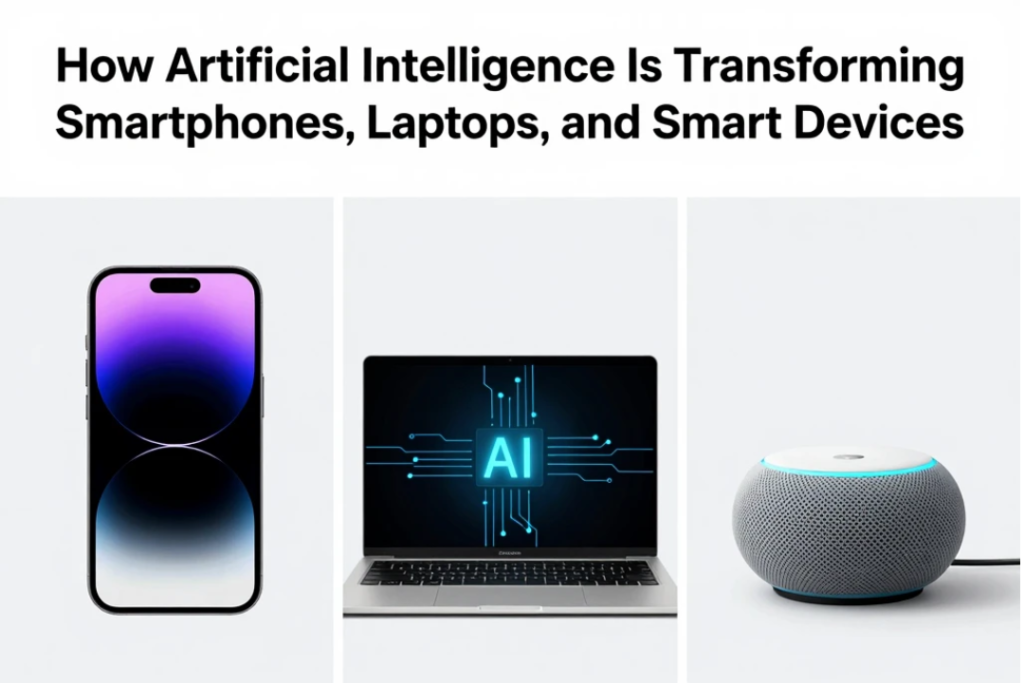
Artificial intelligence is no longer limited to research laboratories, large data centers, or futuristic concepts. It has quietly become part of the technology people use every day.
From smartphones that improve photos automatically to laptops that can assist with writing and video calls, AI is changing the way modern devices work. Smart TVs, earbuds, watches, cameras, home appliances, and other connected products are also becoming more intelligent.
The biggest change is that devices are moving beyond simply following commands. They can increasingly understand context, recognize patterns, personalize experiences, automate repetitive tasks, and help users complete activities more efficiently.
This transformation is making AI in smartphones, laptops, and smart devices one of the most important developments in consumer technology.
But what exactly is changing, and how will AI affect the devices we use every day?
What Is AI Doing Inside Modern Devices?
Artificial intelligence allows devices to process information and identify patterns in ways that can make them more useful.
Traditional electronic devices generally depend on fixed instructions. For example, a basic camera takes a picture when you press a button.
An AI-powered camera can go further by recognizing scenes, identifying subjects, adjusting settings, reducing noise, improving exposure, and processing the final image.
The same concept applies to laptops, smartphones, smartwatches, televisions, and other devices.
AI can help devices:
- Understand voice commands
- Recognize images and objects
- Improve photographs
- Predict user behavior
- Translate languages
- Summarize information
- Personalize recommendations
- Detect unusual activity
- Automate repetitive tasks
- Improve accessibility
- Optimize performance and power consumption
As AI hardware becomes more common, more of these functions can also happen directly on the device.
How AI Is Transforming Smartphones
Smartphones are among the clearest examples of everyday AI technology.
Modern phones contain cameras, microphones, sensors, powerful processors, connectivity hardware, and increasingly dedicated AI processing capabilities.
Together, these components allow smartphones to perform tasks that would have seemed advanced only a few years ago.
1. Smarter Smartphone Cameras
AI has transformed smartphone photography.
Modern phones can automatically recognize scenes and adjust image processing according to the situation.
For example, AI-assisted photography can help with:
- Portrait photography
- Night photography
- HDR processing
- Face detection
- Object recognition
- Image sharpening
- Noise reduction
- Background separation
Computational photography also allows smartphones to combine information from multiple frames and processing techniques to create better-looking images.
This means camera quality is no longer determined only by the physical camera sensor.
Software and AI can be equally important.
2. AI-Powered Photo Editing
AI has also made photo editing easier.
Instead of manually adjusting every element of a picture, users can increasingly use intelligent editing features to remove unwanted objects, improve lighting, adjust backgrounds, or make other changes.
These tools can save time for casual users who may not have professional editing experience.
For content creators, AI-powered editing can also speed up routine tasks.
3. Smarter Voice Assistants
Voice interaction is another major area where AI is changing smartphones.
Users can speak naturally instead of relying entirely on menus and buttons.
AI-powered assistants can help with tasks such as:
- Setting reminders
- Finding information
- Sending messages
- Managing schedules
- Controlling compatible smart devices
- Translating phrases
- Answering questions
As language models become more capable, smartphone interaction may become increasingly conversational.
4. On-Device AI
One of the most important developments is the growth of on-device AI.
Instead of sending every task to a remote server, some AI processing can happen directly on the smartphone.
This can provide several advantages, including potentially faster responses, reduced dependence on an internet connection for certain features, and improved privacy for some types of processing.
However, exactly what can run locally depends on the device’s hardware and software.
5. Personalized Smartphone Experiences
AI can learn patterns from how people use their devices.
For example, a smartphone may optimize app behavior, notifications, battery usage, or recommendations based on usage patterns.
The goal is to make the device feel more personalized instead of behaving exactly the same way for every user.
How AI Is Transforming Laptops
Laptops are also undergoing a major transformation.
Modern AI-powered computers are increasingly designed to handle AI workloads locally while also supporting cloud-based AI services.
This is changing productivity, communication, creativity, and everyday computing.
1. AI Productivity Tools
One of the biggest advantages of AI laptops is assistance with everyday work.
AI tools can help users:
- Summarize documents
- Draft emails
- Rewrite text
- Organize information
- Generate ideas
- Analyze data
- Create presentations
- Assist with coding
Instead of replacing every traditional application, AI is increasingly being integrated into applications people already use.
2. Better Video Meetings
AI can also improve video conferencing.
Depending on the software and hardware, AI-powered features may help with:
- Background effects
- Noise reduction
- Voice enhancement
- Automatic framing
- Eye-contact effects
- Lighting adjustments
- Transcription
These features can make remote meetings easier, particularly when users are working in less-than-perfect environments.
3. AI-Assisted Coding
Software developers are another major group benefiting from AI-powered laptops and applications.
AI coding tools can assist with:
- Code generation
- Code explanation
- Debugging suggestions
- Documentation
- Repetitive programming tasks
- Code completion
Developers still need to review generated code carefully, but AI can reduce the amount of time spent on repetitive work.
4. Smarter Power Management
AI may also help laptops manage power more intelligently.
Instead of applying the same power settings all the time, intelligent systems can analyze workload patterns and adjust performance, background activity, or other settings.
The goal is to balance performance and battery life.
5. AI Hardware in Modern Laptops
Many newer laptops are being designed with specialized hardware for AI workloads.
These components can help handle certain AI operations efficiently without depending entirely on the main processor.
This trend is contributing to the rise of what the industry commonly calls AI PCs.
AI Is Making Smart Devices More Intelligent
The transformation doesn’t stop with phones and laptops.
AI is also spreading across a wide range of smart devices.
Smartwatches
Smartwatches can use AI-related technologies to make health, fitness, communication, and personalization features more useful.
Depending on the model and available software, AI can assist with activity insights, sleep-related analysis, notifications, voice interaction, and personalized recommendations.
AI does not turn a smartwatch into a medical diagnostic device, however. Health-related readings and insights should be interpreted appropriately and not automatically treated as professional medical diagnoses.
Smart TVs
Smart TVs can use AI to improve recommendations, image processing, sound processing, voice interaction, and content discovery.
Instead of simply displaying channels and applications, modern televisions can increasingly adapt to how people use them.
Wireless Earbuds
AI can also improve audio devices.
Features may include:
- Noise reduction
- Voice enhancement
- Adaptive sound
- Environmental awareness
- Translation assistance
- Call-quality improvements
This can make small accessories much more capable than traditional headphones.
Smart Home Devices
Smart speakers, cameras, thermostats, lights, and other connected devices can use AI to understand patterns and automate certain activities.
For example, a smart home system may recognize routines and allow users to control multiple devices through voice or automated rules.
The challenge is balancing convenience with privacy and security.
AI Is Improving Device Security
Security is another important area where artificial intelligence can make a difference.
AI-based systems can identify unusual patterns and potentially detect suspicious activity.
On smartphones and laptops, intelligent security technologies can assist with:
- Suspicious behavior detection
- Spam identification
- Phishing detection
- Malware analysis
- Biometric recognition
- Unusual login activity
AI is not a complete replacement for traditional cybersecurity practices, but it can provide another layer of protection.
Users should still keep software updated, use strong passwords, enable multi-factor authentication where available, and avoid suspicious links.
AI and Personalization
One of AI’s most noticeable effects is personalization.
Modern devices can increasingly adapt to individual users.
For example, a device may learn which applications are used most frequently, which notifications matter, what content is preferred, or when certain functions are commonly used.
This can make technology feel more intuitive.
However, personalization often requires data.
That creates an important question:
How much personal information should a device collect to provide a more personalized experience?
Consumers should understand privacy settings and know what information their devices and applications collect.
AI Is Changing Accessibility
AI can also make technology easier to use for people with different accessibility needs.
Features can include:
- Speech recognition
- Text-to-speech
- Automatic captions
- Image descriptions
- Voice control
- Translation
- Noise reduction
- Visual assistance
These tools can make smartphones, laptops, and smart devices more accessible to a wider range of users.
This is one of the areas where AI’s impact may be particularly meaningful because better software can reduce barriers to technology.
Cloud AI vs On-Device AI
There are two broad approaches to AI processing.
Cloud-Based AI
Cloud AI sends information to remote servers for processing.
Advantages can include:
- Access to powerful computing resources
- Larger models
- Frequent server-side improvements
- Ability to handle demanding workloads
However, cloud-based systems generally depend on network connectivity and require careful consideration of privacy and data handling.
On-Device AI
On-device AI performs at least some processing locally.
Potential advantages include:
- Faster response for supported tasks
- Reduced network dependency
- Potentially better privacy for certain workloads
- Lower need to send some information to remote servers
The most practical future may involve a combination of both approaches.
Benefits of AI-Powered Devices
AI is bringing several important advantages to consumer technology.
| Benefit | How AI Helps |
|---|---|
| Productivity | Automates repetitive tasks |
| Photography | Improves images and editing |
| Communication | Enables smarter voice and language tools |
| Accessibility | Supports captions, speech, and visual assistance |
| Security | Detects unusual patterns |
| Personalization | Adapts experiences to user behavior |
| Entertainment | Improves recommendations |
| Battery management | Can optimize certain workloads |
| Creativity | Helps generate and edit content |
The exact benefits vary depending on the device, software, and AI capabilities available.
Challenges of AI-Powered Devices
Despite the benefits, AI-powered technology also creates new challenges.
Privacy
AI features can process personal information, including voice, images, documents, location-related information, and usage patterns.
Users should understand how their data is collected and processed.
Accuracy
AI can make mistakes.
A generated answer, recommendation, summary, or interpretation should not automatically be assumed to be correct.
Security
As devices become more intelligent and connected, protecting them becomes increasingly important.
Cost
New AI hardware and premium AI features can increase the cost of devices.
Consumers should consider whether those features provide meaningful value before paying extra.
Dependence on AI
There is also a risk of becoming overly dependent on automated systems.
AI should generally be treated as an assistant rather than an unquestionable authority.
The Future of AI in Smartphones, Laptops, and Smart Devices
The next generation of devices is likely to become more context-aware and personalized.
Smartphones may increasingly act as AI assistants capable of understanding what users are doing and helping them complete multi-step tasks.
Laptops may become more capable AI workstations, combining local processing with cloud services.
Smart home systems could become more coordinated, allowing multiple devices to work together instead of operating as isolated products.
We may also see greater integration between smartphones, watches, earbuds, laptops, vehicles, and home devices.
The result could be a more connected technology ecosystem where AI operates across multiple devices.
However, the future will also require better privacy controls, stronger security, transparent AI systems, and clearer user control.
Frequently Asked Questions
How is AI changing smartphones?
AI is improving smartphone photography, voice assistants, translation, personalization, security, editing, battery optimization, and many other functions.
What are AI laptops?
AI laptops are computers designed with hardware and software that can efficiently support certain AI workloads. Many include specialized processors for AI-related tasks.
Are smart devices powered by AI?
Many modern smart devices use some form of AI or machine learning, although the exact capabilities vary significantly between products.
Is on-device AI better than cloud AI?
Neither is universally better. On-device AI can provide advantages for supported tasks such as local processing and reduced network dependence, while cloud AI can provide access to larger and more computationally demanding models.
Will AI replace smartphones and laptops?
AI is more likely to change how smartphones and laptops work than simply replace them. These devices are becoming interfaces for increasingly capable AI systems.
Final Thoughts
Artificial intelligence is transforming smartphones, laptops, and smart devices from simple electronic tools into increasingly intelligent computing platforms.
On smartphones, AI is improving photography, voice interaction, personalization, security, and productivity. On laptops, it is helping with writing, coding, meetings, content creation, and other everyday tasks. Across smartwatches, earbuds, televisions, and smart home products, AI is creating new ways for devices to understand users and respond to their needs.
The biggest shift is not simply that devices are becoming more powerful. They are becoming more context-aware, personalized, and capable of assisting users.
As AI technology continues to develop, the devices of the future may rely less on users manually controlling every feature and more on intelligent systems that understand what users are trying to accomplish.
The challenge will be ensuring that this increased intelligence comes with strong privacy, security, transparency, and user control.
When those elements are balanced properly, AI could make everyday technology significantly more useful without making it unnecessarily complicated.