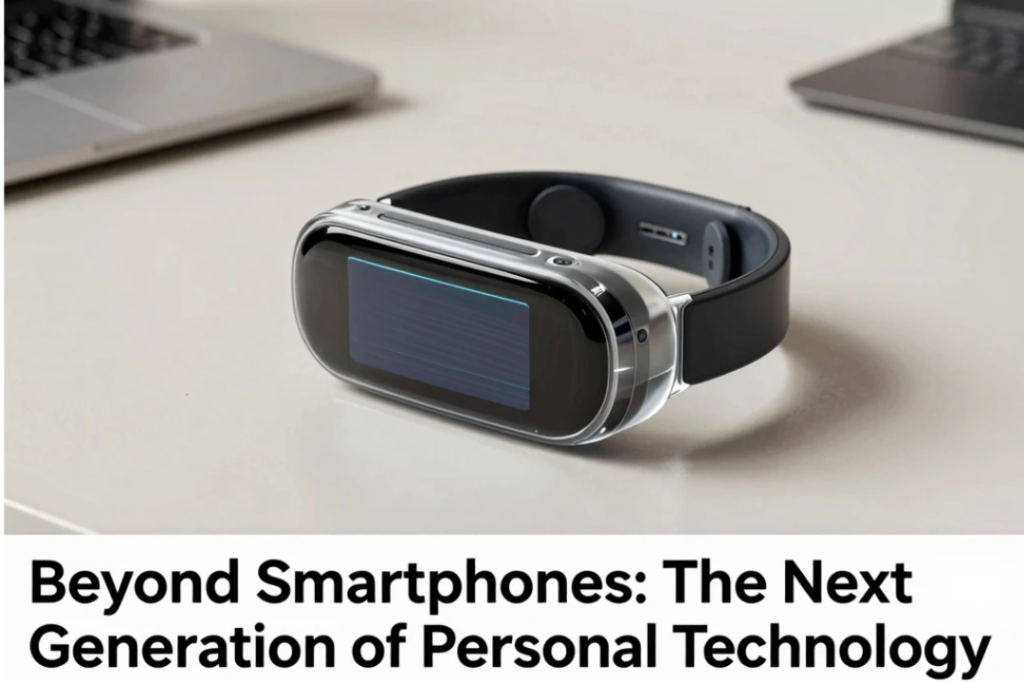
For more than a decade, the smartphone has been at the center of personal technology. It became our camera, map, communication device, entertainment system, payment tool, productivity assistant, and gateway to the internet.
But personal technology is beginning to change.
The next major shift may not be about building an even larger smartphone with more cameras or a faster processor. Instead, technology could become more distributed across the devices we wear, carry, and use around us.
Smart glasses, smart rings, AI-powered earbuds, advanced wearables, spatial computing, intelligent assistants, and connected devices are all contributing to a future in which the smartphone may no longer be the only primary interface.
This does not mean smartphones are disappearing anytime soon. Instead, they could become one part of a much larger personal technology ecosystem.
Here is what the next generation of personal technology could look like.
The Smartphone Is Becoming One Part of the Ecosystem
The smartphone has traditionally been the central device connecting everything else.
Smartwatches, earbuds, laptops, cars, smart home products, and other accessories often depend on smartphones for setup, communication, or internet connectivity.
The future could be more distributed.
Instead of asking users to constantly interact with one screen, different devices could handle different tasks.
For example:
- Smart glasses could provide visual information.
- Earbuds could handle voice interactions.
- Smart rings could monitor selected activity metrics.
- Watches could provide quick notifications.
- AI assistants could coordinate information.
- Laptops could handle demanding work.
- Smart home systems could automate the environment.
The result could be a more natural technology experience.
1. AI-Powered Personal Assistants
Artificial intelligence could become the foundation of next-generation personal technology.
Today’s users often open an application and then give it an instruction.
Future AI assistants could become more deeply integrated into the user’s digital environment.
An AI assistant could potentially understand:
- Calendar information
- Messages
- Tasks
- Preferences
- Location context
- Device activity
- Work patterns
With appropriate permissions, it could help coordinate different parts of daily life.
For example, instead of manually checking several applications, a user could ask an AI assistant for a summary of the day’s important tasks.
The major change is not simply smarter AI.
It is AI becoming a more natural interface between people and technology.
2. Smart Glasses Could Become the Next Major Interface
Smart glasses are one of the most interesting technologies beyond smartphones.
Instead of looking down at a phone, users could potentially access digital information through a wearable display.
Possible applications include:
- Navigation
- Translation
- Notifications
- Video calls
- Remote assistance
- Educational information
- Accessibility features
- Hands-free instructions
Imagine walking through an unfamiliar city and receiving navigation guidance without constantly checking your phone.
Or imagine looking at text in another language and receiving translation assistance through your glasses.
For smart glasses to become mainstream, however, several challenges must be solved.
They need to be comfortable, stylish, energy-efficient, affordable, and socially acceptable.
Privacy will be equally important.
3. Smart Rings and Smaller Wearables
Not every wearable needs a large screen.
Smart rings demonstrate how technology can become smaller and less intrusive.
A ring can potentially provide selected activity and health-related measurements without requiring users to wear a large device.
Future wearable technology could become even more discreet.
Instead of carrying a collection of large devices, people may use several small sensors that communicate with each other.
This could make personal technology feel less like carrying electronics and more like simply wearing everyday objects.
4. AI-Powered Earbuds
Wireless earbuds have already become common.
The next generation could make them significantly smarter.
AI-powered earbuds could potentially provide:
- Real-time translation
- Voice assistants
- Noise management
- Personalized audio
- Meeting assistance
- Voice commands
- Context-aware information
Because earbuds are already worn throughout the day, they could become an important interface for AI.
Instead of typing a question into a smartphone, users could simply speak naturally.
5. Spatial Computing
Spatial computing aims to blend digital information with physical environments.
Instead of interacting with a flat screen, users can interact with digital objects in a three-dimensional space.
Potential applications include:
- Education
- Gaming
- Design
- Engineering
- Training
- Entertainment
- Remote collaboration
- Visualization
For example, a student could explore a three-dimensional model rather than looking at a traditional diagram.
An engineer could visualize a digital model in a physical environment.
A designer could interact with virtual objects at realistic scale.
This could change how people think about computing.
6. Personal Technology Without Constant Screens
One of the most interesting possibilities is a reduction in screen dependence.
For years, the smartphone has required users to look at a screen for almost everything.
Future devices could move more interactions toward:
- Voice
- Audio
- Gestures
- Eye tracking
- Context-aware automation
- Wearable displays
This does not mean screens will disappear.
Instead, screens could become one interface among many.
For some tasks, a traditional display will remain the fastest and most practical option.
7. Health and Wellness Technology
Wearable technology could become increasingly important for personal health and wellness.
Smartwatches, rings, earbuds, and other sensors can already collect different types of activity information.
Future devices may provide more personalized insights based on long-term patterns.
Potential applications could include:
- Activity monitoring
- Sleep tracking
- Fitness guidance
- Recovery information
- Wellness reminders
- Remote health monitoring
However, there is an important distinction between wellness technology and medical diagnosis.
Consumers should not assume that every wearable measurement is medically accurate or suitable for diagnosing a condition.
8. Personal Technology Will Become More Context-Aware
Future devices may become better at understanding context.
Today, users often need to tell technology exactly what they want.
Future systems could potentially recognize situations and provide appropriate assistance.
For example:
At work: The system prioritizes meetings and productivity.
While traveling: It provides navigation and translation assistance.
During exercise: It focuses on fitness-related information.
At home: It controls connected devices.
While driving: It minimizes distracting notifications.
This could make technology feel more personalized without requiring constant manual control.
9. Connected Clothing and Smart Accessories
Personal technology could eventually move into clothing and everyday accessories.
Smart clothing could potentially include sensors that monitor movement, temperature, or other measurements.
Connected backpacks, glasses, shoes, and other accessories could also become more intelligent.
The challenge is making these technologies practical.
Consumers generally do not want complicated devices that require constant charging or maintenance.
Successful smart accessories will likely be those that provide useful features without adding unnecessary complexity.
10. Personal AI Memory
One potentially important development is AI that can help users organize their personal digital information.
Imagine an assistant that can help you find information from your own notes, documents, schedules, conversations, and projects.
Instead of remembering where something was saved, you could ask a natural-language question.
For example:
“Where did I save the information about that project?”
The system could potentially search authorized personal data and provide the relevant information.
This could make digital organization significantly easier.
But personal AI memory also creates major privacy questions.
Users need clear controls over what information is stored, accessed, and deleted.
11. Technology Will Become More Proactive
Today’s devices mostly wait for instructions.
The next generation could become more proactive.
Instead of simply displaying notifications, systems could prioritize information based on context.
For example, rather than showing every notification immediately, an AI system could identify which messages are urgent and which can wait.
The goal would be to reduce information overload.
However, proactive technology must still respect user control.
A device should assist users without becoming overly intrusive.
12. The Personal Technology Ecosystem
The future is unlikely to be dominated by one device.
Instead, people may use a collection of connected technologies.
| Device | Potential Role |
|---|---|
| Smartphone | Central computing and communication |
| Smart Glasses | Visual information |
| Smart Ring | Discreet sensing |
| Smartwatch | Notifications and fitness |
| Earbuds | Audio and voice AI |
| Laptop | Productivity and demanding work |
| AI Assistant | Coordination and automation |
| Smart Home | Environmental automation |
| Electric Vehicle | Connected transportation |
The important part is communication between these devices.
A powerful ecosystem could make technology feel seamless.
13. More On-Device AI
Another major trend is AI processing directly on personal devices.
Traditionally, many AI workloads depended heavily on cloud servers.
As chips become more capable, some AI processing can increasingly happen locally.
Potential benefits include:
- Faster responses
- Lower latency
- Better offline functionality
- Reduced data transmission
- Improved privacy for certain tasks
This could be particularly important for wearable devices and smartphones.
A device that can perform useful AI processing locally does not always need to send every interaction to a remote server.
14. Battery Technology Will Become Critical
One of the biggest limitations of personal technology is battery life.
Adding more sensors, displays, AI processing, and connectivity requires energy.
Future devices will therefore need improvements in:
- Battery capacity
- Power efficiency
- Charging speed
- Processor efficiency
- Energy management
This is especially important for small devices such as smart rings and earbuds.
A futuristic device is not very useful if it needs to be charged constantly.
15. Privacy Will Become a Major Product Feature
The more personal technology knows about users, the more important privacy becomes.
Future devices could have access to extremely personal information, including location, health-related data, conversations, preferences, and daily routines.
Consumers should therefore pay attention to:
- Data collection
- Permission controls
- Encryption
- Account security
- Data retention
- Sharing policies
- Local processing
Privacy should not be treated as an optional feature.
It should be part of the design of personal technology.
16. Will Smartphones Disappear?
Probably not in the near future.
Smartphones remain extremely practical because they combine a powerful processor, large display, camera, connectivity, storage, and applications in one portable device.
Even if smart glasses and AI wearables become more popular, smartphones may continue serving as a powerful central device.
The bigger change may be that users interact with their phones less frequently for simple tasks.
Instead of opening a phone for every notification, search, or navigation request, users may rely more on voice, wearables, and ambient computing.
What Will Personal Technology Look Like by 2030?
By 2030, personal technology could become:
- More intelligent
- More personalized
- More wearable
- More connected
- More voice-driven
- More context-aware
- More automated
- Less dependent on a single screen
The smartphone may still be present, but it could increasingly become the central hub of a much broader technology ecosystem.
How Consumers Should Prepare
Consumers do not need to buy every emerging device.
Instead, focus on technologies that solve real problems.
Before buying a new gadget, ask:
- Does it solve a problem I actually have?
- Does it work with my existing devices?
- How long will it receive software support?
- How often does it need charging?
- What information does it collect?
- Can I control its privacy settings?
- Is the price justified by its usefulness?
This approach can prevent unnecessary spending on technology that looks futuristic but provides little practical value.
Frequently Asked Questions
What is the next generation of personal technology?
It refers to emerging technologies that could extend personal computing beyond traditional smartphones, including AI assistants, smart glasses, smart rings, advanced wearables, spatial computing, and connected devices.
Will smart glasses replace smartphones?
They may reduce the need to use smartphones for certain tasks, but smartphones are likely to remain important because of their versatility, large displays, cameras, applications, and computing capabilities.
Are smart rings the future of wearable technology?
Smart rings are one promising direction because they can provide useful sensing capabilities in a small form factor. Their long-term success will depend on comfort, accuracy, battery life, software, and consumer demand.
What role will AI play in personal technology?
AI could become the intelligence layer connecting different personal devices. It may help users communicate with technology more naturally and automate repetitive tasks.
Will personal technology become more private?
It could, particularly as more AI processing moves onto local devices. However, privacy will ultimately depend on product design, policies, security practices, and user controls.
What personal technology should I buy today?
Choose devices that solve real problems rather than buying something simply because it is marketed as futuristic. Compatibility, battery life, software support, privacy, and long-term usefulness should all be considered.
Final Thoughts
The future of personal technology is unlikely to be about simply replacing the smartphone with one new device.
Instead, computing could become distributed across an ecosystem of smart glasses, rings, earbuds, watches, AI assistants, laptops, vehicles, and connected environments.
The most important change may be the way we interact with technology.
Instead of constantly reaching for a screen, we could increasingly communicate with technology through voice, wearables, gestures, intelligent automation, and context-aware systems.
The smartphone may remain an important part of this future, but it may no longer be the only device at the center of our digital lives.
The next generation of personal technology will ultimately succeed if it makes everyday life simpler, more useful, more accessible, and more personalized—not merely more complicated.