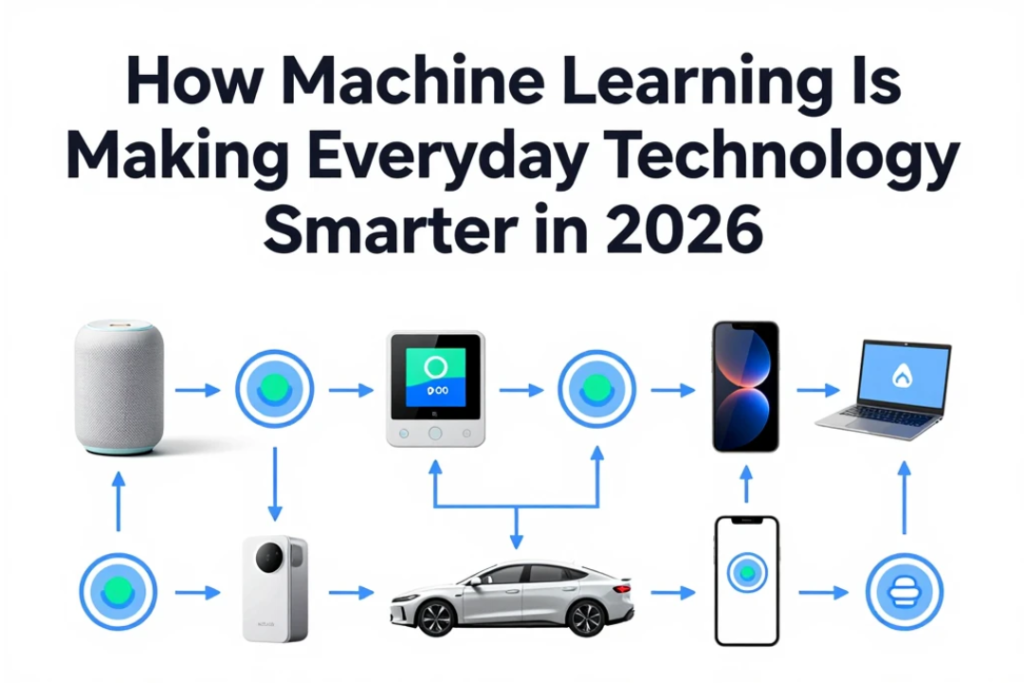
Machine learning has become one of the most important technologies behind modern digital products. While artificial intelligence often gets the most attention, machine learning is quietly working in the background of many technologies people use every day.
From smartphone cameras and search engines to streaming services, smartwatches, banking systems, navigation apps, and smart home devices, machine learning helps software recognize patterns, make predictions, personalize experiences, and automate tasks.
In 2026, this technology is becoming even more deeply integrated into everyday products.
The interesting part is that many people use machine learning without realizing it. You do not necessarily need to open an AI application to benefit from it. Your phone may already be using machine learning every time you unlock it, take a photograph, receive a spam warning, or search for information.
So, how is machine learning in everyday technology making our devices smarter?
What Is Machine Learning?
Machine learning is a branch of artificial intelligence that allows computer systems to identify patterns in data and use those patterns to make predictions or decisions.
Traditional software generally follows rules that developers explicitly program.
Machine learning systems, by contrast, can learn patterns from examples and data.
For instance, a smartphone camera can be trained using large amounts of image data to recognize objects, faces, scenes, lighting conditions, and other visual characteristics.
The system can then use what it has learned to improve photographs or provide useful features.
This ability to recognize patterns is what makes machine learning so valuable across modern technology.
1. Machine Learning Makes Smartphones Smarter
Smartphones are among the clearest examples of machine learning in everyday life.
Modern phones use machine learning for many functions, including:
- Face recognition
- Camera enhancement
- Voice recognition
- Spam detection
- Battery optimization
- App recommendations
- Text prediction
- Photo organization
- Translation
- Security
Many of these features work automatically.
For example, when your phone recognizes a face in a photograph or predicts the next word while you type, machine learning may be working behind the scenes.
2. Smartphone Cameras Use Machine Learning
Photography has changed significantly because of computational photography and machine learning.
Modern smartphone cameras can analyze an image and make adjustments automatically.
Machine learning can help identify:
- Faces
- People
- Landscapes
- Food
- Animals
- Low-light scenes
- Backgrounds
- Objects
The camera software can then adjust processing based on the scene.
This can improve exposure, colors, noise reduction, portrait effects, and other aspects of an image.
The result is that users can often capture better photographs without manually adjusting complicated camera settings.
3. Voice Assistants Understand Users Better
Voice recognition is another area where machine learning has made major improvements.
Modern voice systems can convert spoken language into text and identify commands.
Machine learning helps systems handle different accents, speaking speeds, background noise, and variations in pronunciation.
This technology supports voice assistants, transcription tools, smart speakers, accessibility features, and hands-free smartphone controls.
As AI and machine learning continue to improve, voice interaction is becoming more natural and useful.
4. Machine Learning Personalizes Search
Search engines and digital platforms use machine learning to understand what users are looking for.
Instead of simply matching exact words, modern systems can analyze context and patterns to provide more relevant results.
Machine learning can also help identify spam, low-quality content, unusual behavior, and potentially misleading information.
For users, this means search experiences can become more personalized and efficient.
However, personalization also raises questions about privacy and how user data is collected and processed.
5. Streaming Services Use Machine Learning
Machine learning is heavily involved in content recommendations.
Streaming platforms can analyze viewing or listening patterns and identify content that may interest a particular user.
Recommendations can be influenced by factors such as:
- Previous activity
- Content preferences
- Viewing habits
- Search behavior
- Similar user patterns
- Time and context
This helps users discover movies, shows, music, podcasts, and other content.
The same principle is used by many social media and online shopping platforms.
6. Smartwatches Use Machine Learning for Health and Fitness
Wearable devices are another major example of machine learning in everyday technology.
Smartwatches and fitness trackers collect various types of information depending on the device.
Machine learning can help analyze patterns in activity, exercise, sleep, heart rate, and other measurements.
Instead of simply displaying raw numbers, software can identify trends and provide easier-to-understand summaries.
For example, a fitness application may recognize exercise patterns or estimate activity levels based on sensor information.
Health-related technology should still be used carefully. Wearable measurements can be useful for tracking and awareness, but they do not replace professional medical evaluation.
7. Navigation Apps Predict Traffic
Navigation applications use machine learning to understand traffic patterns and estimate travel times.
By analyzing large amounts of historical and real-time information, systems can identify areas where traffic is likely to become slower.
This allows navigation applications to suggest alternative routes and provide more useful arrival-time estimates.
Machine learning can also support transportation systems by helping analyze traffic flows and travel patterns.
8. Machine Learning Makes Email Smarter
Email services use machine learning in several ways.
One of the most familiar examples is spam filtering.
Machine learning systems can analyze characteristics of messages and identify patterns associated with unwanted or suspicious emails.
Modern email platforms may also use machine learning to organize messages, suggest responses, prioritize important emails, and identify potentially harmful content.
This reduces the amount of manual work users need to perform.
9. Online Shopping Becomes More Personalized
E-commerce platforms use machine learning to understand customer behavior.
Recommendations can be based on products users have viewed, searched for, purchased, or shown interest in.
Machine learning can also help businesses predict demand, manage inventory, identify fraudulent transactions, and improve search results.
For consumers, this can make it easier to discover relevant products.
However, personalized shopping also means users should remain aware of how platforms use their browsing and purchasing information.
10. Banking Uses Machine Learning for Fraud Detection
Financial institutions use machine learning to identify unusual transaction patterns.
A system can learn what normal activity looks like and flag transactions that appear unusual.
For example, if a transaction differs significantly from a customer’s typical behavior, additional security checks may be triggered.
Machine learning can therefore help financial institutions respond to potential fraud more quickly.
It is one of the areas where machine learning can provide significant practical value behind the scenes.
11. Smart Homes Are Becoming More Intelligent
Smart home devices are also benefiting from machine learning.
Connected systems can learn patterns related to lighting, temperature, energy consumption, and device usage.
Over time, smart home technology may become better at predicting what users want.
For example, a system could potentially recognize regular routines and adjust certain settings automatically.
Machine learning can therefore help transform smart homes from collections of connected gadgets into more responsive environments.
12. Machine Learning Helps Improve Cybersecurity
Cybersecurity is another major application.
Traditional security systems often rely on predefined rules and known threat signatures.
Machine learning can analyze large amounts of activity and identify unusual patterns that may indicate a security problem.
This can help detect suspicious login behavior, unusual network activity, malware patterns, or other potential threats.
However, machine learning is not a perfect security solution. Human expertise, secure system design, software updates, and strong authentication remain essential.
13. Cars Are Becoming Smarter
Modern vehicles increasingly use sensors, cameras, software, and machine learning.
Machine learning can support driver-assistance features such as object detection, lane-related assistance, parking systems, and collision warnings, depending on the vehicle.
Electric vehicles can also use intelligent software to optimize battery management and energy consumption.
The automotive industry is therefore becoming increasingly connected to the broader AI and machine learning ecosystem.
Drivers should always understand the capabilities and limitations of driver-assistance systems rather than assuming that a vehicle can operate completely independently.
14. Machine Learning Improves Translation
Language translation has also benefited significantly from machine learning.
Modern translation systems can analyze large amounts of multilingual information and learn patterns between languages.
This allows software to provide increasingly useful translations for text, websites, conversations, and other applications.
Real-time translation features could become particularly useful in smartphones, earbuds, smart glasses, and communication applications.
15. Machine Learning Helps Software Become More Accessible
Machine learning can also make technology easier to use for people with different accessibility needs.
Examples include:
- Speech-to-text
- Text-to-speech
- Image descriptions
- Voice control
- Noise reduction
- Automatic captions
- Object recognition
These technologies can make digital services more accessible and allow more people to interact with devices in ways that suit their individual needs.
16. On-Device Machine Learning Is Growing
One of the important developments in machine learning 2026 is the increasing ability of devices to process certain AI workloads locally.
Instead of sending every piece of information to a cloud server, some tasks can be processed directly on smartphones, laptops, and other devices.
Potential advantages include:
- Faster responses
- Reduced network dependence
- Better offline functionality
- Potential privacy benefits
- Lower latency
This trend is closely connected to the development of specialized AI hardware in modern devices.
17. Machine Learning Is Making Software More Predictive
Traditional software generally waits for the user to provide an instruction.
Machine learning allows software to become more predictive.
Applications can anticipate what a user might want based on previous behavior.
Examples include:
- Suggested replies
- Recommended content
- Predictive text
- Automatic photo organization
- Traffic predictions
- Product recommendations
- Personalized news
- Smart notifications
This can save time, but personalization should always be balanced with transparency and user control.
Machine Learning in Everyday Technology
| Technology | How Machine Learning Helps |
|---|---|
| Smartphones | Personalization, security, camera features |
| Cameras | Scene recognition and image processing |
| Smartwatches | Activity and wellness pattern analysis |
| Navigation | Traffic and route predictions |
| Spam detection and organization | |
| Streaming | Content recommendations |
| Shopping | Product recommendations |
| Banking | Fraud detection |
| Smart Homes | Automated routines |
| Cars | Driver-assistance features |
| Translation | Language processing |
| Cybersecurity | Threat and anomaly detection |
The Benefits of Machine Learning
The biggest advantage of machine learning is its ability to process large amounts of information and identify patterns that would be difficult to manage manually.
For everyday users, this can translate into:
- More personalized experiences
- Faster software
- Better recommendations
- Improved security
- Easier communication
- Better accessibility
- Smarter automation
- More useful devices
The technology often works quietly in the background, which is why many people may not realize how much machine learning they already use.
Challenges and Concerns
Machine learning also comes with challenges.
Privacy is an important concern because many systems rely on large amounts of data.
Accuracy is another issue. A machine learning system can produce incorrect predictions or recommendations.
Bias can also occur if the data used to develop a system is incomplete or unbalanced.
There are also questions about transparency. Users may not always understand why an algorithm made a particular recommendation or decision.
For these reasons, responsible development, strong privacy protections, security, testing, and human oversight remain important.
What Machine Learning Could Look Like in the Future
Machine learning is likely to become even less visible as it becomes more integrated into everyday products.
Future devices may understand context more effectively and provide assistance before users explicitly ask for it.
Smartphones, laptops, wearables, vehicles, and homes could increasingly work together.
The result could be a more seamless digital environment in which technology automatically adapts to people’s needs.
However, the best future will not simply be about making technology more intelligent.
It will also require better privacy controls, transparent systems, secure infrastructure, and meaningful user choice.
Final Thoughts
Machine learning in everyday technology is already changing how modern devices work.
From smartphone cameras and voice assistants to navigation, banking, smart homes, wearables, cybersecurity, and online shopping, machine learning is helping technology recognize patterns and make smarter predictions.
In 2026, the biggest development is that machine learning is becoming more deeply integrated into everyday products.
Users may not always see it, but it is increasingly working behind the scenes to make software faster, more personalized, more convenient, and more automated.
As devices gain more powerful AI hardware and on-device processing capabilities, machine learning could become even more important.
The future of smart technology will therefore not simply depend on bigger processors or more features. It will depend on how effectively technology can understand context, learn from information, assist users, and perform useful tasks while respecting privacy and security.
Machine learning is already making everyday technology smarter—and its influence is likely to become even more noticeable in the years ahead.
Frequently Asked Questions
What is machine learning in simple terms?
Machine learning is a type of artificial intelligence that allows computers to identify patterns in data and use those patterns to make predictions, recommendations, or decisions.
How is machine learning used in everyday life?
It is used in smartphone cameras, search engines, navigation apps, streaming recommendations, email spam filters, banking fraud detection, smartwatches, online shopping, smart homes, and cybersecurity.
Is machine learning the same as AI?
Machine learning is a major approach within artificial intelligence. AI is the broader field, while machine learning focuses on systems that learn patterns from data.
Do smartphones use machine learning?
Yes. Modern smartphones can use machine learning for photography, facial recognition, voice recognition, text prediction, personalization, security, battery optimization, and other features.
Is machine learning safe?
Machine learning can be very useful, but it has limitations involving accuracy, privacy, bias, and security. Responsible development and human oversight are important, especially for sensitive applications.
What is the future of machine learning?
Machine learning is likely to become more integrated into everyday devices and software, with greater use of on-device processing, AI assistants, personalization, automation, robotics, and intelligent connected systems.