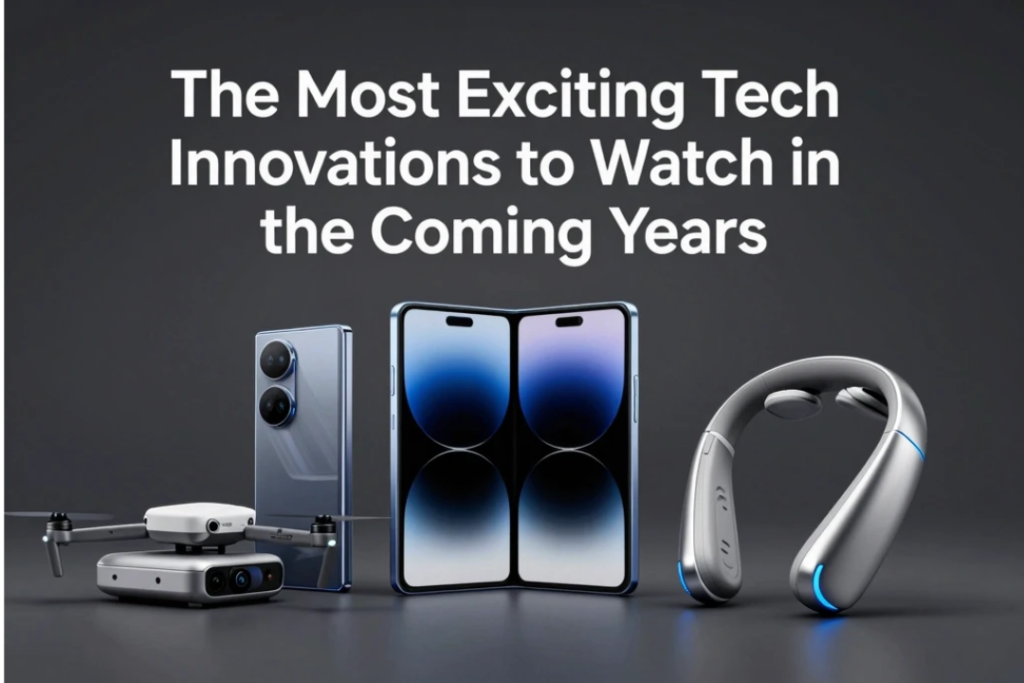
Technology is moving at an incredible pace. Every year brings new devices, software, services, and breakthroughs that change how people work, communicate, learn, travel, and entertain themselves.
But some innovations are more important than others.
The most exciting technologies are not necessarily the products receiving the most attention today. Some are still developing behind the scenes and could have a much bigger impact in the coming years as costs fall, hardware improves, and businesses find practical applications.
From artificial intelligence and robotics to quantum computing, smart wearables, advanced batteries, and immersive technology, the future could bring major changes to everyday life.
Here are some of the most exciting tech innovations to watch in the coming years.
1. More Capable Artificial Intelligence
Artificial intelligence is already transforming digital technology, but its development is far from finished.
AI systems are becoming increasingly useful for:
- Writing
- Research
- Coding
- Data analysis
- Image creation
- Translation
- Education
- Business automation
- Personal productivity
The next phase could involve AI becoming more deeply integrated into the applications people already use.
Instead of opening a dedicated AI application, users may simply interact with AI inside their operating system, browser, smartphone, office software, or other everyday tools.
This could make AI feel less like a separate product and more like an invisible layer of digital assistance.
2. AI Agents That Can Handle Complex Tasks
One of the most interesting developments in AI is the move from simple chatbots toward AI agents.
A traditional chatbot primarily responds to prompts.
An AI agent can potentially understand a goal, create a plan, use tools, evaluate results, and complete multiple steps with varying levels of human supervision.
Possible applications include:
- Research
- Customer service
- Scheduling
- Software development
- Business administration
- Marketing
- Data processing
Imagine giving an AI assistant a broad objective and having it organize the necessary steps rather than requiring instructions for every individual action.
This could significantly change how people interact with software.
However, human approval and permission controls will remain important for sensitive or high-impact tasks.
3. AI-Powered Personal Devices
The smartphone, laptop, and wearable device could become much smarter as AI moves directly into personal hardware.
On-device AI can allow certain tasks to be processed locally rather than always relying on cloud servers.
Potential advantages include:
- Faster responses
- Lower latency
- Better offline functionality
- Reduced data transmission
- More personalized experiences
Future smartphones and laptops may use AI not only for chat and image generation but also for battery management, search, communication, accessibility, security, and productivity.
4. Smart Glasses and New Interfaces
Smart glasses could become one of the most important alternatives to traditional screens.
Instead of constantly looking at a smartphone, users could potentially receive information through lightweight wearable displays.
Possible applications include:
- Navigation
- Translation
- Notifications
- Video calls
- Remote assistance
- Education
- Entertainment
The technology still needs to overcome challenges involving battery life, comfort, design, privacy, and price.
If those challenges are solved, smart glasses could become a major personal computing platform.
5. Spatial Computing
Spatial computing is another technology worth watching.
It allows digital information and objects to be represented within three-dimensional environments.
This could change industries such as:
- Engineering
- Architecture
- Education
- Healthcare
- Gaming
- Training
- Design
Instead of looking at a flat diagram, a user could interact with a three-dimensional digital representation.
This could make complex information easier to visualize and understand.
6. Next-Generation Wearables
Wearable technology is expanding beyond smartwatches.
Future wearable devices may include:
- Smart rings
- AI-powered earbuds
- Smart glasses
- Health sensors
- Specialized fitness devices
- Connected clothing
Smaller sensors could make personal technology less noticeable while still collecting useful information.
The biggest opportunity may be personalization.
Wearables could provide insights based on long-term patterns instead of simply showing individual measurements.
However, health-related data requires careful handling, and consumers should understand the limitations of consumer wearable measurements.
7. More Advanced Robotics
Robotics is moving beyond factories and warehouses.
AI is making robots better at recognizing objects, navigating environments, and responding to changing situations.
Future robots could become more common in:
- Healthcare
- Agriculture
- Logistics
- Construction
- Hospitality
- Manufacturing
- Home assistance
The most successful robots may not be humanoid machines.
Specialized robots designed to perform one task efficiently could become much more practical.
8. Humanoid Robots
Humanoid robots deserve separate attention because researchers and companies are exploring machines designed to operate in environments created for humans.
A human-shaped robot could potentially use existing:
- Doors
- Stairs
- Tools
- Workspaces
- Vehicles
- Equipment
If robotics hardware, AI, sensors, and battery technology continue improving, humanoid systems could eventually perform selected tasks in industrial or commercial environments.
However, widespread consumer adoption is far from guaranteed.
Cost, safety, reliability, maintenance, and regulation will all matter.
9. Quantum Computing
Quantum computing remains one of the most fascinating areas of advanced technology.
Unlike traditional computers, quantum computers use quantum systems to process information in fundamentally different ways.
Their potential applications include:
- Scientific simulations
- Drug discovery
- Materials research
- Optimization
- Cryptography
Quantum computers are not expected to replace smartphones or laptops.
Instead, they may eventually work alongside conventional computing systems to solve specialized problems that are extremely difficult for classical computers.
The technology remains challenging, but its long-term potential makes it worth watching.
10. Advanced Battery Technology
Battery technology is essential for almost every modern device.
Better batteries could improve:
- Smartphones
- Laptops
- Electric vehicles
- Drones
- Robots
- Wearables
- Portable energy systems
The goal is not simply increasing capacity.
Future batteries may aim to provide better energy density, faster charging, longer lifespans, improved safety, and lower environmental impact.
Battery innovation could have an enormous effect because so many technologies depend on portable power.
11. Smarter Electric Vehicles
Electric vehicles are becoming increasingly sophisticated.
Future EVs may combine advanced batteries, AI, connectivity, software, and driver-assistance technologies.
Possible improvements include:
- Longer practical range
- Faster charging
- Smarter route planning
- Better energy management
- Improved driver assistance
- More connected vehicle systems
Vehicles are increasingly becoming software platforms as well as transportation machines.
12. Autonomous Transportation
Self-driving technology continues to develop, although adoption will likely vary by location and use case.
Future autonomous systems could potentially be used for:
- Robotaxis
- Delivery vehicles
- Public transportation
- Logistics
- Warehouses
- Industrial environments
Fully autonomous transportation requires more than advanced AI.
It also depends on sensors, mapping, infrastructure, regulation, safety testing, and public trust.
13. Digital Twins
Digital twins could become increasingly important for businesses and infrastructure.
A digital twin is a digital representation of a physical object, machine, building, or system.
Real-world data can be used to update the digital representation.
This can help organizations:
- Monitor performance
- Predict potential problems
- Test changes
- Improve efficiency
- Reduce maintenance costs
Digital twins could become especially useful in manufacturing, transportation, energy, construction, and smart cities.
14. Next-Generation Connectivity
Future technology depends on reliable communication.
As more devices become connected, networks will need to support huge numbers of devices while maintaining speed and reliability.
Advanced connectivity could enable:
- Smart cities
- Connected vehicles
- Remote healthcare
- Industrial automation
- Immersive experiences
- Large-scale IoT
Connectivity may become less noticeable to consumers while becoming more important behind the scenes.
15. AI-Powered Healthcare
Healthcare is another field where technology could produce major changes.
AI can assist with information analysis, medical research, administrative work, and other healthcare workflows.
Wearable devices may also provide more continuous health and fitness information.
Future technology could help with:
- Remote monitoring
- Medical research
- Imaging assistance
- Personalized healthcare
- Patient communication
- Administrative automation
The goal should be to support qualified healthcare professionals rather than replace professional judgment.
16. Brain-Computer Interfaces
Brain-computer interfaces are designed to create communication pathways between brain activity and digital systems.
Although the technology is still developing, potential applications include accessibility, rehabilitation, medical research, and new forms of human-computer interaction.
In the long term, BCIs could potentially allow people to control certain digital systems through neural signals.
However, major technical, ethical, privacy, and medical challenges remain.
This makes BCIs a technology to watch rather than a technology consumers should expect to become mainstream immediately.
17. Sustainable Technology
Technology innovation will increasingly need to consider environmental impact.
Future products could focus more on:
- Energy efficiency
- Longer lifespans
- Repairability
- Recyclable materials
- Efficient processors
- Renewable energy
- Reduced electronic waste
Sustainable design may become an important part of product development as consumers and governments pay more attention to resource consumption.
18. AI-Powered Creativity
AI is changing creative work as well.
Creators can already use AI to assist with:
- Writing
- Images
- Video
- Audio
- Brainstorming
- Editing
- Research
Future creative tools could provide more sophisticated assistance while giving users greater control.
The strongest creative workflows are likely to combine AI’s speed with human judgment, storytelling, originality, and taste.
Which Innovations Could Have the Biggest Impact?
| Innovation | Potential Impact |
|---|---|
| Advanced AI | Smarter software and automation |
| AI Agents | Multi-step digital work |
| Smart Glasses | New personal computing interface |
| Robotics | Physical automation |
| Quantum Computing | Specialized advanced computing |
| Battery Technology | Better mobile and electric devices |
| Spatial Computing | Immersive digital experiences |
| Digital Twins | Smarter industrial systems |
| Advanced Connectivity | Connected environments |
| AI Healthcare | Better digital health workflows |
| Brain-Computer Interfaces | New human-computer interaction |
| Sustainable Tech | More efficient technology |
What Will Make These Technologies Successful?
A technology does not become successful simply because it is impressive.
It must solve a real problem.
Successful innovations usually need a combination of:
- Reliability
- Affordable pricing
- Good user experience
- Strong security
- Useful features
- Long-term support
- Practical infrastructure
- Consumer trust
For example, a futuristic wearable may have impressive specifications, but if its battery lasts only a few hours and the device is uncomfortable, consumers may not use it regularly.
Practicality often matters more than novelty.
What Consumers Should Watch For
When new technologies appear, marketing can make every product sound revolutionary.
Consumers should therefore ask:
Does this solve a real problem?
How reliable is it?
Does it work with my existing devices?
How long will it receive updates?
What data does it collect?
Is the price justified?
These questions can help separate genuinely useful innovations from short-lived technology trends.
Frequently Asked Questions
What are the most exciting tech innovations to watch?
AI agents, smart glasses, advanced robotics, quantum computing, spatial computing, next-generation batteries, digital twins, advanced connectivity, and AI-powered healthcare are among the technologies worth watching.
Will AI be the biggest technology of the future?
AI has the potential to become one of the most influential technologies because it can be integrated into many other products and industries.
Will quantum computing become mainstream?
Quantum computing is more likely to remain a specialized technology rather than replacing everyday computers. Its biggest impact may come from scientific and computational applications.
Are smart glasses going to replace smartphones?
They could handle some tasks currently performed on smartphones, but smartphones are likely to remain useful because they offer large displays, powerful computing, cameras, and extensive applications.
Will robots become common in homes?
Household robots may become more capable over time, but widespread adoption will depend on affordability, safety, reliability, and practical usefulness.
Which future technology should consumers pay attention to?
Consumers should focus on technologies that provide clear practical benefits rather than simply following the latest trend.
Final Thoughts
The coming years could bring some of the most exciting technological developments in decades.
Artificial intelligence may become more autonomous and deeply integrated into everyday software. Smart glasses could create new ways to access information. Robots may take on more physical tasks, while quantum computing could unlock new possibilities in specialized scientific and computational fields.
At the same time, advances in batteries, connectivity, healthcare technology, spatial computing, and sustainable design could support an entirely new generation of digital products.
The most exciting part is that these innovations will not develop independently.
They will increasingly work together.
AI could power robots. Better batteries could enable smarter wearables. Advanced connectivity could connect vehicles and smart cities. Spatial computing could provide new interfaces for AI.
The future of technology will therefore be less about one revolutionary gadget and more about an ecosystem of technologies working together.
For consumers, businesses, and creators, the best approach is to stay curious, evaluate new products carefully, and focus on innovations that make technology genuinely more useful.