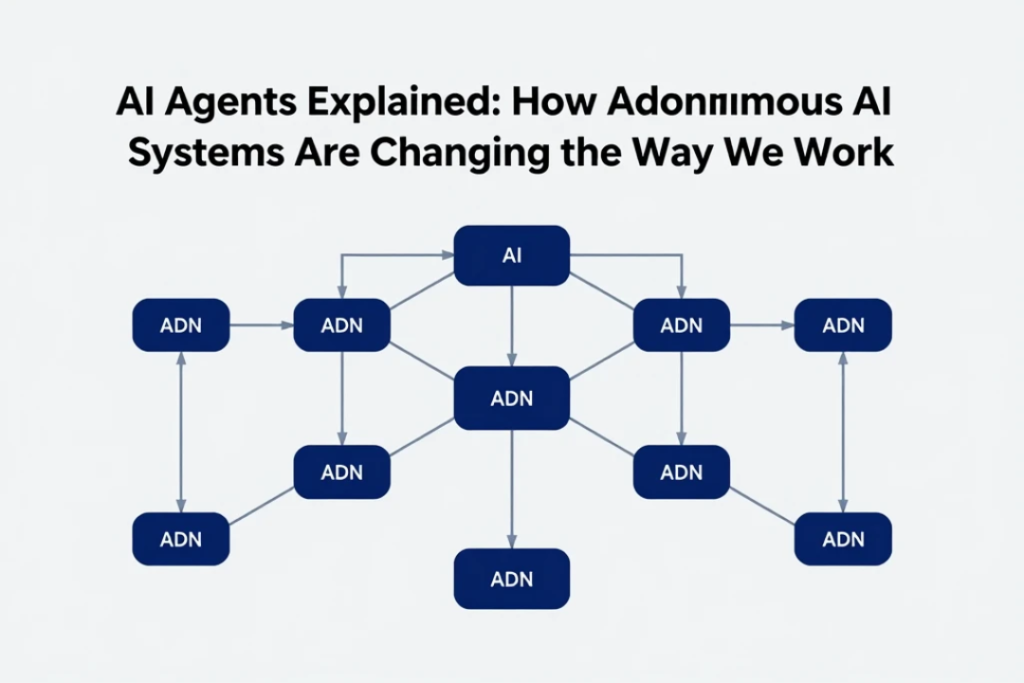
Artificial intelligence has evolved far beyond simple chatbots and basic automation. In 2026, one of the most important developments in AI is the rise of AI agents—systems designed to understand goals, make decisions, use digital tools, and complete tasks with less step-by-step human instruction.
Traditional software usually waits for a user to tell it exactly what to do. An AI agent can take a broader objective and determine a sequence of actions needed to achieve it.
For example, instead of simply asking an AI system to write an email, an AI agent could potentially review relevant information, prepare a draft, organize supporting details, and move through an approved workflow.
This shift could have a major impact on workplaces.
AI agents are becoming increasingly relevant to software development, customer service, research, marketing, administration, data analysis, and many other areas.
But what exactly are AI agents, how do they work, and what makes them different from traditional AI tools?
What Are AI Agents?
An AI agent is a software system that can use artificial intelligence to pursue a defined goal by planning actions, using tools, evaluating results, and adapting its approach when necessary.
A traditional chatbot generally responds to a prompt.
An AI agent is designed to go further.
It may:
- Understand a goal
- Break the goal into smaller tasks
- Decide what actions are needed
- Use connected tools
- Gather information
- Analyze results
- Complete multiple steps
- Adjust its approach when something changes
The exact capabilities vary significantly between systems.
Not every product marketed as an “AI agent” is fully autonomous. Some systems operate with strict human approval at important stages.
How AI Agents Work
Although implementations differ, many AI agents follow a general workflow.
1. Understand the Goal
The system first interprets what the user wants to accomplish.
For example:
“Prepare a weekly sales report.”
The agent needs to understand what information is required and what the final result should look like.
2. Create a Plan
Instead of producing an immediate answer, the agent can break the task into smaller steps.
It may determine that it needs to collect sales data, organize the numbers, analyze changes, create charts, and prepare a summary.
3. Use Tools
An AI agent can potentially connect to approved software tools, databases, APIs, documents, calendars, or other systems.
This ability is one of the most important differences between an AI agent and a simple chatbot.
4. Evaluate Results
After completing an action, the agent can inspect the result and determine whether another step is necessary.
If information is missing, it may need to retrieve additional information.
5. Complete the Task
Once the required steps are finished, the agent provides the result or sends the output through an approved workflow.
Human approval may still be required for important actions.
AI Agents vs Traditional AI
The difference becomes clearer when comparing traditional AI tools with agent-based systems.
| Feature | Traditional AI | AI Agents |
|---|---|---|
| Main function | Respond to requests | Work toward goals |
| Planning | Usually limited | Can involve multiple steps |
| Tool use | May be limited | Often central to operation |
| Autonomy | Lower | Potentially higher |
| Task duration | Usually short | Can involve longer workflows |
| Adaptation | Limited | Can adjust based on results |
| Human involvement | Often direct | Can be continuous or approval-based |
This does not mean AI agents are automatically better.
For simple tasks, a normal AI assistant may be faster and easier.
Agents become more useful when a task requires multiple steps and interaction with other systems.
Why AI Agents Matter for Businesses
Businesses perform many repetitive workflows that involve moving information between different applications.
Employees may spend hours:
- Reading emails
- Updating spreadsheets
- Preparing reports
- Sorting information
- Creating documents
- Scheduling meetings
- Responding to routine requests
- Checking databases
- Monitoring processes
AI agents could help automate parts of these workflows.
Instead of replacing an entire employee’s role, an agent may handle repetitive steps while humans remain responsible for decisions, approvals, and exceptions.
This can allow workers to spend more time on higher-value activities.
AI Agents in Customer Service
Customer service is one of the areas where agent-based AI can have a significant impact.
A basic chatbot might answer frequently asked questions.
A more capable AI agent could potentially understand a customer’s problem, retrieve account information from approved systems, follow troubleshooting procedures, and escalate complex cases.
For example, a customer might report a billing problem.
An agent could identify the account, review the relevant information, determine whether the issue matches an approved resolution, and prepare the appropriate response.
Human intervention can remain available for unusual or sensitive cases.
AI Agents for Software Development
Software development is another major area of interest.
AI coding agents can potentially help developers understand codebases, write code, identify bugs, generate tests, and assist with documentation.
Instead of asking an AI only for a single code snippet, developers can give it a broader development task and allow it to work through multiple steps within a controlled environment.
However, generated code still needs human review.
Security vulnerabilities, incorrect assumptions, and unexpected behavior can occur, especially when an AI system interacts with complex software projects.
AI Agents for Research
Research often involves gathering information from multiple sources, organizing findings, comparing information, and producing summaries.
AI agents could assist with parts of this process.
For example, an agent might be instructed to:
- Find relevant sources.
- Extract useful information.
- Organize findings.
- Compare different claims.
- Prepare a structured summary.
Human verification remains essential, especially when research is being used for academic, scientific, legal, medical, or business decisions.
AI Agents in Marketing
Marketing teams manage many repetitive activities.
AI agents can potentially assist with:
- Content planning
- Campaign analysis
- Customer segmentation
- Report generation
- Competitor monitoring
- Social media workflows
- Email campaign preparation
- Data analysis
The agent can help automate operational work while marketers focus on strategy, brand positioning, creative direction, and final decisions.
AI Agents for Administrative Work
Administrative tasks are another strong use case.
Businesses often spend significant time scheduling meetings, organizing documents, preparing reports, processing requests, and moving information between applications.
An AI agent could potentially coordinate several of these steps.
For example, a scheduling agent could review availability, identify suitable times, prepare meeting information, and request approval before sending invitations.
The more systems an agent can access, the more important permission controls become.
AI Agents and Personal Productivity
AI agents are not only for large companies.
Individuals may use agent-like systems to organize daily tasks, summarize information, manage schedules, plan projects, or assist with research.
Imagine telling an AI system:
“Help me organize this week’s work.”
Instead of simply creating a list, a more advanced agent could review available tasks, prioritize them according to rules, identify deadlines, and create a proposed schedule.
The user could then review and approve the plan.
The Importance of Human Oversight
Autonomy is powerful, but it also introduces risks.
An AI agent that can access multiple systems has more ability to make mistakes than a simple chatbot that only generates text.
For this reason, businesses need appropriate controls.
Important safeguards can include:
- Permission limits
- Human approval
- Activity logs
- Access controls
- Data protection
- Testing
- Error handling
- Monitoring
- Clear boundaries
A useful principle is to give an AI agent only the permissions it actually needs.
AI Agent Security Risks
AI agents can create new cybersecurity challenges.
If an agent can access email, files, databases, or business applications, a compromised or incorrectly configured system could potentially cause significant problems.
Organizations need to consider risks such as unauthorized access, sensitive-data exposure, malicious instructions, incorrect actions, and excessive permissions.
Agent security should therefore be treated as part of the overall cybersecurity strategy rather than an afterthought.
Are AI Agents Fully Autonomous?
Not necessarily.
The word “autonomous” can be misleading because AI agents exist on a spectrum.
Some systems require approval after every major action.
Others can complete several steps independently but ask for confirmation before sensitive operations.
More autonomous systems may be allowed to continue working within clearly defined limits.
The safest approach depends on the task.
An agent writing a draft may not need much supervision.
An agent making financial transactions should require significantly stronger controls.
Benefits of AI Agents
When properly designed, AI agents can offer several advantages.
Greater Productivity
Agents can automate repetitive workflows and reduce manual effort.
Faster Task Completion
Multi-step processes can potentially be completed faster when software handles routine operations.
Better Consistency
Automated workflows can follow predefined rules consistently.
24/7 Operation
Software systems can potentially continue working outside normal business hours.
Scalability
An automated workflow can potentially handle larger volumes without requiring the same increase in manual labor.
Limitations of AI Agents
AI agents are not perfect.
They can misunderstand instructions, make incorrect decisions, use poor information, or fail when a workflow changes unexpectedly.
They can also struggle with ambiguous goals.
A human employee may understand an unusual situation using common sense and experience, while an AI agent may follow an incorrect assumption.
For this reason, human oversight remains important.
How AI Agents Could Change Jobs
The impact on employment is likely to be more complicated than simply “AI replaces workers.”
Some tasks may become automated.
Other jobs may change as employees spend less time on repetitive activities and more time supervising AI systems, making decisions, solving unusual problems, and working with customers.
New roles may also develop around AI system management, evaluation, security, and workflow design.
The most valuable skill may increasingly be knowing how to work effectively with AI rather than competing against it.
What the Future of AI Agents Could Look Like
AI agents may eventually become a normal layer between people and software.
Instead of manually opening multiple applications, users could describe a goal and allow an AI system to coordinate the necessary tools.
For example, a business owner might ask an agent to prepare a weekly operations summary.
The agent could gather approved information from different business systems, identify important changes, prepare a report, and present it for human review.
This could make software interaction more goal-oriented.
Instead of learning exactly where every feature is located, users may increasingly tell software what they want to accomplish.
How Businesses Should Prepare
Companies considering AI agents should start with practical, low-risk workflows.
A sensible approach is:
- Identify repetitive tasks.
- Choose workflows with clear rules.
- Start with limited permissions.
- Test the system.
- Monitor performance.
- Keep humans involved in important decisions.
- Expand gradually.
Businesses should focus on measurable improvements rather than adopting AI simply because it is a trend.
Final Thoughts
AI agents represent an important evolution in artificial intelligence.
Instead of simply answering questions or generating content, agent-based systems can potentially plan tasks, use tools, evaluate results, and work toward defined goals.
This could change how businesses handle customer service, software development, research, marketing, administration, and everyday productivity.
However, greater autonomy also means greater responsibility. AI agents need appropriate permissions, monitoring, security controls, and human oversight.
The future is unlikely to be about humans completely handing control to AI. A more practical future is one where people define goals, provide direction, review important decisions, and let AI handle suitable parts of complex workflows.
As AI agents become more capable, knowing how to use them responsibly could become an important digital skill for both individuals and businesses.
Frequently Asked Questions
What is an AI agent?
An AI agent is an AI-powered software system designed to pursue a goal by planning actions, using tools, evaluating results, and completing multiple steps with varying levels of human supervision.
How are AI agents different from chatbots?
A chatbot generally responds to user prompts, while an AI agent can potentially plan and execute multiple steps toward a broader objective.
Can AI agents work without humans?
Some AI agents can operate with a high degree of autonomy, but the level of human involvement depends on the system and task. Sensitive activities should generally include appropriate human approval.
How can businesses use AI agents?
Businesses can use AI agents for customer service, research, software development, reporting, administration, marketing workflows, data analysis, and other repetitive processes.
Are AI agents safe?
AI agents can be useful, but their ability to access tools and systems creates security and reliability risks. Permission controls, monitoring, testing, and human oversight are important.
Will AI agents replace employees?
AI agents may automate certain tasks and change job responsibilities, but many roles still require human judgment, creativity, communication, accountability, and decision-making.
Are AI agents useful for individuals?
Yes. Depending on the tools available, individuals can use agent-based AI for productivity, research, scheduling, organization, writing, and other multi-step tasks.