Introduction
Artificial intelligence has become an important part of modern life. From smartphones and online shopping to healthcare and education, AI is changing how people work, communicate, and solve everyday problems. At the center of this transformation are AI models, which help computers understand information, recognize patterns, generate content, and make predictions.
Today, businesses use AI models to improve customer service, analyze large amounts of data, and automate repetitive tasks. Students use AI-powered tools to learn new concepts, while doctors can use intelligent systems to support medical research and diagnosis. These technologies are becoming more accessible, making artificial intelligence useful for individuals and organizations across different industries.
Understanding AI models is essential for anyone interested in technology and its future. This article explores what AI models are, how they work, their different types, their practical applications, and the challenges associated with their use.
What Are AI Models?
AI models are computer systems trained to perform specific tasks by learning patterns from data. Instead of following only a fixed set of instructions, many AI models use examples to identify relationships and produce useful results.
For example, an image recognition model can learn to distinguish between cats and dogs by analyzing thousands of labeled images. After training, it can examine a new image and estimate which animal it contains.
Similarly, language models learn patterns in text and can use those patterns to answer questions, summarize documents, translate languages, and generate written content.
AI models are developed using different techniques, depending on the task they need to perform. Some are designed to predict future outcomes, while others create new text, images, audio, or video.
In simple terms, an AI model is the part of an artificial intelligence system that has learned how to perform a particular task using data and mathematical methods.
How Do AI Models Work?
The development of an AI model usually involves several important steps. Although the process varies between models, the general principles remain similar.
1. Data Collection
AI models need information to learn patterns. This information may include text, images, audio recordings, videos, or numerical data.
For example, a model designed to recognize plant diseases may be trained using photographs of healthy and infected leaves. The quality and variety of these photographs can strongly influence its performance.
2. Data Preparation
Raw data is not always suitable for training. It may contain errors, duplicate information, missing values, or irrelevant details. Developers prepare the data to make it more useful and consistent.
Careful preparation helps reduce avoidable mistakes and improves the reliability of the training process.
3. Model Training
During training, an algorithm processes examples and adjusts its internal parameters to learn patterns. The model repeatedly compares its predictions with the expected results and uses an optimization process to reduce errors.
This stage may require substantial computing power, particularly for large AI models.
4. Testing and Evaluation
Once training is complete, developers evaluate the model using data that was not used during training. This helps them understand whether the model can handle new situations rather than simply memorizing its training examples.
5. Deployment and Improvement
After testing, an AI model may be integrated into a website, mobile application, business platform, or other software system. Developers can monitor its performance and update it when necessary.
AI models are not automatically accurate in every situation. Their results depend on the quality of their training, the task they perform, and the information they receive.
Different Types of AI Models
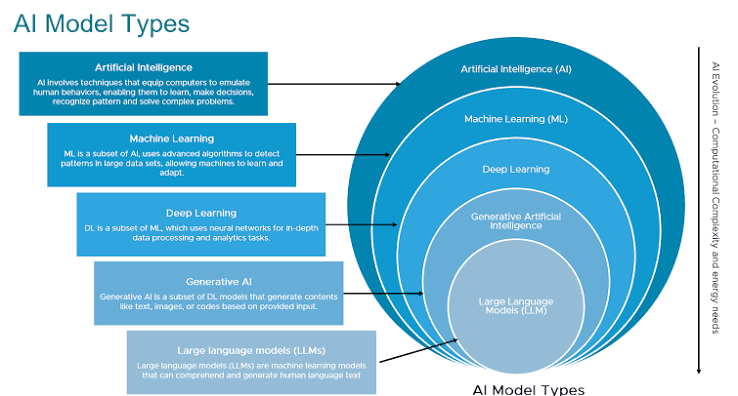
AI models come in several forms, and each type serves different purposes. Understanding these categories makes it easier to recognize how artificial intelligence works in real-world applications.
Machine Learning Models
Machine learning models learn patterns from data and use them to make predictions or decisions. They are commonly used for fraud detection, customer analysis, sales forecasting, and recommendation systems.
For example, an online store may use a machine learning model to recommend products based on a customer’s browsing activity and previous purchases.
Popular machine learning approaches include decision trees, linear regression, random forests, and support vector machines.
Deep Learning Models
Deep learning is a specialized area of machine learning that uses artificial neural networks with multiple layers. These models can identify complex patterns in large datasets.
Deep learning is widely used in speech recognition, image analysis, natural language processing, and autonomous systems.
For instance, a deep learning model can help a computer vision system identify pedestrians, traffic signs, and vehicles in road images.
Large Language Models
Large language models, commonly called LLMs, are trained on extensive collections of text and other language-related data. They can generate responses, explain concepts, summarize information, assist with coding, and perform many language-based tasks.
These models power many conversational AI applications. However, they can sometimes produce inaccurate statements or misunderstand a question, so their answers should be checked when accuracy is important.
Generative AI Models
Generative AI models create new content based on patterns learned during training. Depending on their design, they can generate articles, illustrations, music, voice recordings, and videos.
These tools are useful for creative projects, marketing, entertainment, and content development.
Generative models can save time and support creativity, but users should consider copyright, originality, and the possibility of misleading or fabricated content.
Predictive AI Models
Predictive AI models estimate future outcomes using historical and current information. Businesses may use them to forecast demand, estimate delivery times, identify equipment failures, or evaluate financial risks.
For example, a retailer can analyze previous sales and seasonal trends to estimate how much inventory it will need next month.
The accuracy of these predictions depends on the available data and whether the patterns remain relevant.
Real-World Applications of AI Models
AI models are no longer limited to research laboratories. They are being used across many industries to improve efficiency and support decision-making.
Healthcare
Healthcare organizations can use AI models to analyze medical images, organize patient information, support research, and identify patterns that may be difficult to notice manually.
Some models can assist specialists in examining X-rays or other scans. However, medical AI requires careful testing, privacy protection, and professional oversight. It should support qualified healthcare professionals rather than automatically replace their judgment.
Education
AI models are creating new opportunities for students and teachers. They can explain difficult subjects, generate practice questions, summarize lessons, and help learners study at their own pace.
Teachers may also use AI tools to prepare educational materials and develop personalized learning activities.
However, students should use these tools to improve understanding rather than depend on them for every answer. Independent thinking and fact-checking remain essential.
Business and Marketing
Companies use AI models to analyze customer behavior, identify market trends, automate routine communication, and improve advertising campaigns.
Customer service chatbots can answer common questions at any time, while predictive models can help businesses estimate demand and manage inventory.
These applications may reduce repetitive work and allow employees to focus on tasks that require creativity, communication, and human judgment.
Finance
Financial institutions use AI models to detect suspicious transactions, assess certain types of risk, and identify unusual spending patterns.
For example, a fraud detection model may flag a transaction that differs significantly from a customer’s normal activity.
Financial models must be monitored carefully because incorrect predictions can affect customers, businesses, and investment decisions.
Everyday Technology
AI models also operate behind many familiar digital services. They help email platforms filter spam, streaming services recommend entertainment, navigation applications estimate travel times, and smartphones recognize speech.
These applications demonstrate that artificial intelligence is not limited to advanced research. It is already integrated into many ordinary activities.
Benefits of AI Models
One of the main advantages of AI models is their ability to process large amounts of information quickly. Tasks that would take people considerable time can sometimes be completed in seconds.
AI models can also improve consistency in repetitive processes, helping organizations reduce certain types of human error. When properly designed, they can identify patterns that support better planning and decision-making.
Another benefit is automation. Businesses can use AI systems to handle routine tasks, allowing employees to spend more time on complex problems and customer relationships.
AI models can also support accessibility. Speech-to-text applications, translation tools, image descriptions, and other AI-powered features can help people interact with digital information in different ways.
Despite these advantages, AI should not be viewed as a perfect solution. Its usefulness depends on appropriate implementation, reliable data, and human supervision.
Challenges and Limitations of AI Models
Although AI models offer many opportunities, they also introduce important challenges.
Data Quality and Bias
AI models learn from the information used to train them. If that information is incomplete, inaccurate, or biased, the resulting system may produce unfair or unreliable outcomes.
Developers need to evaluate training data carefully and test models with different groups and real-world scenarios.
Privacy and Security
Training and operating AI systems may involve sensitive information. Organizations must protect personal data, follow applicable privacy laws, and establish clear rules for data access and storage.
Users should also avoid entering confidential information into AI services unless they understand how that information may be handled.
Accuracy and Reliability
AI models can make mistakes even when their answers sound convincing. Language models, in particular, may generate incorrect facts, misleading explanations, or nonexistent references.
Important information should therefore be verified using trustworthy sources, especially in healthcare, law, finance, and other high-impact fields.
Cost and Environmental Impact
Developing and operating advanced AI models can require powerful hardware, electricity, technical expertise, and significant financial investment.
Organizations should consider whether a complex model is necessary or whether a smaller, more efficient solution would meet their needs.
Ethical Concerns
The use of AI raises questions about accountability, transparency, job changes, misinformation, and intellectual property. Responsible development requires clear policies, appropriate safeguards, and meaningful human oversight.
How to Choose the Right AI Model
Choosing an AI model begins with understanding the problem that needs to be solved. A business that wants to predict product demand may need a different approach from a designer who wants to generate images.
First, identify the task and define what a successful result looks like. Next, consider the available data, expected accuracy, budget, privacy requirements, and technical resources.
It is also useful to compare several models using the same evaluation criteria. Speed, cost, reliability, ease of integration, and performance on real examples can all influence the final decision.
For some applications, a smaller specialized model may be more practical than a large general-purpose system. In other cases, a general-purpose model may offer greater flexibility.
Testing a model before relying on it is one of the most effective ways to understand its strengths and weaknesses.
The Future of AI Models
The development of AI models continues to evolve. Researchers are working toward systems that are more efficient, capable, accessible, and reliable.
One important direction is the development of smaller models that can run directly on personal devices. These models may improve response times and reduce the need to send certain information to remote servers.
Another trend is multimodal AI, which can process combinations of text, images, audio, and video. Such systems may make digital tools more useful for communication, education, research, and creative work.
AI models are also becoming increasingly integrated into workplace software and everyday applications. This may change how people complete tasks, learn skills, and collaborate with technology.
However, future progress will depend on more than model size or performance. Privacy, safety, transparency, energy efficiency, and public trust will remain important considerations.
Conclusion
AI models are an essential part of modern artificial intelligence. They allow computers to learn from data, recognize patterns, generate content, and support decisions across a wide range of activities.
From healthcare and education to finance and everyday digital services, these models are creating new opportunities for individuals and organizations. At the same time, challenges involving bias, privacy, accuracy, cost, and responsible use cannot be ignored.
Understanding how AI models work helps people make more informed decisions about when and how to use them. The most effective approach is to combine the speed and analytical abilities of artificial intelligence with human experience, critical thinking, and accountability.
As technology continues to advance, AI models will likely become even more integrated into daily life. Learning about their capabilities and limitations today can help individuals and businesses prepare for a future in which artificial intelligence plays an increasingly important role.