Introduction
Artificial intelligence is entering a new phase in which machines are learning to work with more than one type of information at a time. For years, many AI systems were designed around a specific task. Some focused on understanding written language, others specialized in recognizing images, while separate technologies handled speech recognition, audio processing, and video analysis. Although these systems achieved impressive results, they often operated independently, limiting their ability to understand situations that involved several types of information together.
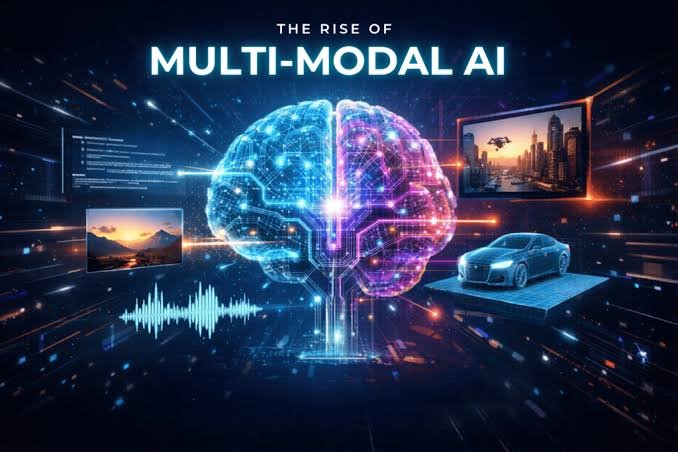
Today, multimodal artificial intelligence is changing that approach. By combining the ability to process text, images, audio, and video, modern AI systems can interpret information in ways that more closely reflect how people experience the world. A user can upload a photograph and ask questions about it, describe a problem verbally, share a video for analysis, or combine written instructions with visual information to complete a task.
Imagine taking a picture of a complicated machine, recording the unusual sound it makes, and asking an AI assistant to help identify the possible problem. A traditional text-based system might struggle without a detailed written description. A multimodal system, however, may be able to examine the photograph, analyze the audio, and use the user’s explanation to provide a more informed response.
This ability to connect different forms of information is opening new opportunities across education, healthcare, business, entertainment, manufacturing, and everyday communication.
Multimodal AI is not simply another improvement in chatbot technology. It represents a broader shift toward intelligent systems that can interpret different kinds of inputs and combine them to support more complex tasks.
However, this development also raises important questions about accuracy, privacy, security, accessibility, and the limitations of machine understanding.
This article explores what multimodal AI is, how it works, why it is growing in importance, and how it may transform the future of intelligent technology.
1. What Is Multimodal AI?
Multimodal AI refers to artificial intelligence systems that can process, interpret, or generate information across multiple modalities. In this context, a modality is a particular form of information, such as text, images, audio, or video.
Traditional language models primarily work with text. They can answer questions, summarize documents, generate ideas, and assist with writing. Image recognition systems, meanwhile, focus on identifying objects, interpreting scenes, and analyzing visual patterns.
Multimodal AI brings these capabilities together, allowing a system to work with several information types within a shared interaction or task.
For example, a user might provide a photograph of a restaurant menu and ask for a translation. The system must interpret the visual information, recognize the written words, understand the language, and generate a translated response.
Another user might provide a recorded lecture and request a summary. Depending on its capabilities, the AI could use speech recognition, identify the main topics, organize the information, and produce written notes.
Video introduces another layer of complexity because it combines visual information across time with audio and sometimes accompanying text. Understanding a video may require identifying objects, recognizing actions, following changes between scenes, and connecting spoken explanations with what appears on screen.
Multimodal AI is valuable because many real-world problems cannot be understood through a single type of information.
A medical professional may need to consider written patient history alongside medical images. A mechanic may examine a component while listening to its operating sound. A teacher may combine spoken explanations, diagrams, and written exercises.
By connecting these different forms of information, multimodal AI can provide more context-sensitive assistance than a system limited to one input type.
2. How Multimodal AI Works
Multimodal AI relies on machine learning models and processing techniques that allow different forms of information to be represented and interpreted together.
The first challenge is that text, images, audio, and video have very different structures. Text consists of sequences of tokens, images contain spatial arrangements of visual information, audio consists of changing sound signals, and video includes visual frames that evolve over time.
To work with these inputs, AI systems use specialized processing methods that convert information into representations suitable for computational analysis.
For example, an image-processing component may identify visual patterns, while an audio-processing component extracts information from speech or environmental sounds. A language model can interpret written instructions and generate a response.
The system must then connect relevant information across these representations. This may involve learning relationships between words and images, linking spoken language to written meaning, or connecting actions in a video with a verbal description.
Training plays an important role. Models may learn from datasets containing images and captions, speech paired with transcripts, video associated with descriptions, or examples that combine several modalities.
Through this process, they learn statistical relationships that help them interpret new inputs.
Different architectures handle this integration in different ways. Some use separate encoders for individual modalities, while others process multiple input types within a more unified model. Many systems combine several approaches.
Once trained, a multimodal model can receive information through supported input channels and generate an appropriate output, such as text, spoken audio, a description, or a structured analysis.
However, combining information does not guarantee accurate understanding. A model may misidentify an object, misunderstand a speaker, overlook a visual detail, or incorrectly connect events that occur close together.
The quality of multimodal AI depends on the model’s architecture, training data, input quality, available context, and methods of evaluation.
3. Text: The Foundation of Intelligent Communication
Text remains one of the most important components of multimodal AI because it provides a flexible way for people to describe goals, ask questions, and interpret results.
Language models can summarize documents, explain technical concepts, translate content, generate reports, and assist with problem-solving. When text is combined with other modalities, these capabilities become useful in a wider range of situations.
Consider a student studying biology. The student may upload a diagram of the human heart and ask the AI to explain how blood moves through its chambers. The system can use the visual information alongside the written question to provide a more relevant explanation.
In a business environment, an employee might share a chart and request a written summary of the main trends. A multimodal system can interpret the visual presentation, identify important values when legible, and turn the findings into a report.
Text can also provide instructions that guide the interpretation of audio and video. A user might ask an AI to identify the main events in a recording, compare two product photographs, or extract the important points from a presentation.
This flexibility makes natural language a useful interface for complex digital tasks.
Nevertheless, text-based explanations can be misleading if the underlying visual or audio interpretation is incorrect. A polished paragraph does not prove that a system has accurately understood its input.
Users should therefore verify important details, especially when answers involve technical specifications, financial information, legal matters, or safety-sensitive decisions.
When used carefully, text acts as the communication layer that helps people interact with multimodal systems and understand the results they produce.
4. Images: Helping AI Interpret the Visual World
Images contain enormous amounts of information. A single photograph may reveal objects, people, written signs, spatial relationships, colors, and details about the surrounding environment.
Computer vision has long enabled machines to identify objects and classify images. Multimodal AI extends these capabilities by connecting visual interpretation with language and broader reasoning tasks.
A user can upload an image and ask a question about a specific object, request a description of a scene, or seek help interpreting a chart. The system can use the image as context rather than relying exclusively on a written explanation.
In education, students can photograph a science experiment, a mathematical diagram, or a page of handwritten notes and request assistance understanding the material.
In retail, visual AI can help categorize products, compare product features, and support image-based searches. In manufacturing, computer vision can identify certain surface defects or flag components that appear different from expected standards.
Accessibility is another important application. Systems that describe images can help people with visual impairments understand photographs, documents, and selected visual content.
Medical imaging is also an area of significant interest. AI models can assist trained professionals by identifying patterns in radiology images or highlighting findings that may require further examination. These systems must be carefully validated and used within appropriate clinical workflows.
Despite these advances, visual understanding remains imperfect. Images may be blurry, poorly lit, or taken from unusual angles. Small details can be overlooked, and visually similar objects may be confused.
AI can also make incorrect claims about what an image contains, especially when the image is ambiguous.
For reliable results, users should provide clear images, ask focused questions, and independently verify details when accuracy matters.
5. Audio: Understanding Speech and Sound
Audio adds another dimension to artificial intelligence by allowing systems to interpret spoken language and, in some cases, environmental sounds.
Speech recognition converts spoken words into text, making it possible to transcribe meetings, generate captions, and create searchable records of conversations. Audio-language systems can build on this capability to summarize discussions, answer questions about recordings, or generate spoken responses.
For example, a student might record a lecture and ask an AI system to produce organized notes. The system could identify the main topics, create headings, and generate a list of important concepts.
In workplaces, audio AI can assist with meeting summaries, call analysis, voice-controlled interfaces, and transcription of interviews.
Multimodal systems can also connect audio with visual information. During a video presentation, an AI may be able to associate a spoken explanation with a diagram displayed on the screen, depending on the system’s capabilities.
Some models can analyze non-speech sounds as well. In suitable applications, they may help identify patterns associated with machine operation, alarms, or other environmental events.
Voice interfaces are becoming more natural, too. Instead of relying entirely on typed questions, users can interact with AI through spoken conversations.
However, audio interpretation can be affected by background noise, overlapping speakers, unfamiliar accents, recording quality, and specialized vocabulary. A transcription error can change the meaning of a statement, while an incorrectly identified sound can lead to a false conclusion.
Voice data also raises privacy concerns because recordings may contain sensitive personal or business information.
Organizations should establish clear policies for recording, storing, and analyzing audio. Users should be aware of consent requirements and review important transcripts before treating them as official records.
Audio makes AI more accessible and flexible, but dependable performance requires careful attention to context, accuracy, and privacy.
6. Video: Understanding Events Over Time
Video is one of the most complex forms of information for AI to analyze because it combines visual content across many frames and may include speech, music, environmental sounds, and on-screen text.
Understanding a video involves more than identifying objects in individual frames. A system may need to determine what happens first, recognize changes in activity, track moving objects, and connect different events into a coherent sequence.
For example, an AI system analyzing a training video might identify the main stages of a procedure and turn them into written instructions. A student could ask for a summary of a recorded lesson, while a business could use video analysis to locate particular events in a large collection of footage.
In sports, video analysis can help identify movement patterns and summarize selected actions. In manufacturing, it may support monitoring of production processes or the detection of unusual activity.
Video AI can also assist content creators by helping them find relevant scenes, generate captions, produce summaries, or organize recordings into searchable collections.
However, video processing requires substantial computational resources, particularly when systems analyze long recordings at high resolution. Some models examine selected frames rather than processing every moment continuously.
This can create limitations. Important events may occur between sampled frames, and a system may misunderstand the relationship between an action and its outcome.
Audio and visual signals can also conflict. For instance, a soundtrack may not accurately represent the activity shown in a video, or a voice may belong to someone outside the visible scene.
Surveillance applications introduce additional concerns involving consent, privacy, and potential misidentification.
As video understanding improves, AI may become increasingly useful for organizing and interpreting visual information. However, reliable analysis will require attention to timing, context, uncertainty, and the consequences of incorrect conclusions.
7. Why Combining Multiple Modalities Matters
The greatest strength of multimodal AI is not simply that it can process different formats. Its real value comes from connecting information across those formats.
A photograph can show what an object looks like, while an audio recording may reveal how it sounds. A written description can explain the user’s goal, while a video can show how a process unfolds.
Each modality contributes different information, and the combination may provide a more complete picture of a situation.
Consider a technician investigating an industrial machine. A photograph might reveal visible damage, an audio recording might capture an unusual noise, and a written maintenance log might describe previous failures.
A multimodal AI system could help organize these clues and suggest possible explanations for the technician to investigate.
In education, a student may learn more effectively when an explanation combines written text with a relevant diagram and spoken guidance.
In accessibility, combining speech recognition with image descriptions may help users navigate information that would otherwise be difficult to access.
In customer service, a user might submit a photograph of a damaged product alongside a written description of the problem. An AI system could use both sources to help categorize the issue and prepare a response.
However, combining multiple inputs can also introduce conflicting evidence. An image may be unclear, an audio recording may be noisy, or a written description may contain an incorrect assumption.
A capable system must therefore do more than merge information. It should recognize uncertainty, avoid inventing missing details, and request clarification when the evidence is insufficient.
Multimodal AI becomes most valuable when different forms of information complement one another and help users make better-informed decisions.
8. Multimodal AI in Healthcare
Healthcare is a promising area for multimodal AI because medical decisions frequently depend on different types of information.
A patient’s medical history may include written notes, laboratory results, medical images, recorded symptoms, and measurements collected over time. Understanding these sources together can help clinicians build a more complete picture of a patient’s condition.
AI systems are being researched and developed to support tasks such as medical image analysis, clinical documentation, information retrieval, and the organization of complex medical records.
For example, a system might assist a qualified clinician by examining a medical image alongside relevant patient information and identifying findings that deserve closer attention.
Audio tools may help transcribe clinical conversations, while language models can organize notes and summarize medical literature. Combining these capabilities could reduce some administrative burdens and make information easier to review.
Multimodal AI may also support medical education by helping students explore anatomical diagrams, interpret educational videos, and connect visual information with written explanations.
Nevertheless, healthcare is a high-stakes environment. Incorrect interpretations can affect treatment decisions, and information that appears meaningful in one context may be misleading in another.
Medical AI must be evaluated using appropriate clinical evidence, representative datasets, and rigorous testing. It should also protect sensitive patient information and comply with applicable privacy and regulatory requirements.
AI-generated conclusions should not be treated as a substitute for professional judgment. Clinicians must consider the full clinical picture, including information that may be missing from the model’s inputs.
The most responsible use of multimodal AI in healthcare is to support qualified professionals, improve access to information, and reduce repetitive work while maintaining patient safety.
9. Multimodal AI in Education and Learning
Education is becoming increasingly interactive as AI systems gain the ability to interpret different kinds of learning materials.
Students do not learn exclusively through written text. They use diagrams, demonstrations, spoken explanations, experiments, and videos. Multimodal AI can help connect these resources and make educational support more responsive to individual questions.
A student studying physics might upload a diagram of a circuit and ask why a particular arrangement behaves differently from another. The AI could interpret the diagram and explain the relevant concepts.
A language learner could practice speaking, receive feedback on selected aspects of pronunciation, and explore written examples of unfamiliar expressions.
Teachers may use multimodal tools to create lesson summaries, generate questions from instructional videos, or prepare explanations that combine text and images.
These capabilities could make learning more accessible to students who benefit from different teaching approaches or who need additional support outside the classroom.
However, multimodal AI is not always correct. It may misread a handwritten equation, overlook a detail in a diagram, or generate an inaccurate explanation of a scientific concept.
There is also a risk that students may rely on AI to complete assignments without developing their own understanding.
Educational institutions should therefore teach students to evaluate AI outputs, check sources, and use intelligent tools to support learning rather than avoid intellectual effort.
Teachers remain essential for understanding students’ needs, providing meaningful feedback, encouraging curiosity, and developing critical-thinking skills.
When used responsibly, multimodal AI can become a flexible learning companion that helps students explore complex ideas through several forms of information.
10. The Business Opportunities of Multimodal AI
Businesses often manage information in different formats, including emails, spreadsheets, photographs, presentations, recordings, and video. Multimodal AI could help organizations connect these resources and make them easier to search and analyze.
In retail, customers may use images to find products or compare similar items. Businesses can also use image analysis to organize product catalogs and support selected quality-control processes.
In manufacturing, multimodal systems may help workers review technical diagrams, maintenance instructions, sensor information, and recordings of equipment behavior.
Customer support teams could use AI to interpret a submitted photograph alongside a written complaint, helping route the request to the appropriate department.
Media organizations may use AI to transcribe interviews, locate scenes in video archives, summarize recordings, and generate searchable descriptions of content.
Businesses can also use multimodal AI to make internal knowledge more accessible. Employees might ask questions about a presentation, retrieve information from a recorded meeting, or request a summary of a document containing charts and images.
These applications can reduce time spent searching for information and performing repetitive administrative work.
However, successful adoption requires reliable integration with existing systems, clear data-governance policies, and careful evaluation of the technology’s actual performance.
Businesses must also consider whether sensitive information is being shared with external services and whether employees understand the limitations of AI-generated outputs.
The most valuable applications will be those that solve real operational problems, produce measurable improvements, and fit naturally into existing workflows.
11. The Role of Multimodal AI in Robotics
Robots operate in physical environments where information arrives through cameras, microphones, sensors, and other sources. Multimodal AI could help them interpret these inputs and respond more flexibly to changing situations.
A robot working in a warehouse may need to recognize objects visually, interpret spoken instructions, estimate distances, and use sensor information to navigate safely.
A household robot might need to identify an object, understand where it belongs, and respond to a user’s request. A robot assisting in manufacturing may combine visual inspection with equipment data to support specific tasks.
Language-enabled robotic systems are particularly interesting because people could describe goals in ordinary terms rather than relying exclusively on specialized commands.
For example, a worker might ask a compatible robot to locate a particular component and bring it to a designated station. The robot would still need suitable sensors, navigation software, physical capabilities, and safety controls to carry out the task.
Multimodal models may help connect high-level instructions with perception and planning, but they do not automatically solve the physical challenges of robotics.
Real-world environments contain unpredictable obstacles, changing lighting, fragile objects, and situations that may not be represented in training data.
Robots must also distinguish between a task that appears linguistically clear and one that is physically safe to perform.
For this reason, robotic applications require extensive testing, reliable control systems, and safeguards that prevent dangerous actions.
Multimodal AI could make robots easier to instruct and more adaptable, but practical deployment will depend on combining intelligent interpretation with dependable physical control.
12. The Challenges of Accuracy, Bias, and Hallucinations
Despite its potential, multimodal AI introduces several technical and ethical challenges.
One major concern is hallucination. A model may describe an object that is not present, misinterpret spoken words, or generate a video summary containing events that never occurred.
These errors can become more complicated when different modalities are combined. If a model misreads a sign in an image, it may use that incorrect interpretation to support an otherwise convincing answer.
Bias is another concern. If training data does not adequately represent different languages, cultures, environments, or populations, system performance may vary significantly across users and situations.
Audio systems may struggle with certain accents or noisy recordings. Image systems may perform differently under varying lighting conditions, while video models may overlook important actions when camera angles change.
Evaluation is also difficult because multimodal tasks can have several acceptable answers. A useful image description may not match a single reference sentence exactly, making it necessary to assess factual accuracy and relevance rather than wording alone.
Developers must also consider how systems handle uncertainty. When an image is too blurry to identify an object, a reliable model should acknowledge the limitation instead of confidently inventing an answer.
Independent verification is especially important in healthcare, finance, industrial safety, and other areas where mistakes can have serious consequences.
The goal is not to expect perfect AI performance. It is to build systems that are appropriately cautious, transparent about limitations, and designed to reduce the likelihood and impact of errors.
13. Privacy and Security in a Multimodal World
As AI systems become capable of processing photographs, voices, recordings, and video, privacy and security become increasingly important.
An image may contain faces, documents, location clues, or information about a person’s home. Audio recordings can reveal conversations and personal details, while video may capture people’s activities without their knowledge.
When users upload this material to an AI service, they need to understand how the information is processed, stored, and potentially used.
Organizations should also consider whether employees or customers have consented to the collection and analysis of recordings or images.
Deepfakes create an additional challenge. AI can generate or alter realistic images, audio, and video, potentially making it harder to distinguish authentic recordings from fabricated content.
This can enable impersonation, fraud, harassment, and the spread of misinformation.
Security measures may include access controls, encryption, careful handling of sensitive data, provenance information, and systems designed to detect suspicious or manipulated content. No single method can identify every synthetic or altered recording reliably.
Users should verify important claims through trusted sources, especially when a recording appears to show a public figure making a surprising statement or requests money or confidential information.
Developers should minimize unnecessary data collection and make privacy settings understandable.
Trust in multimodal AI will depend not only on the quality of its capabilities but also on whether it protects people from misuse and gives users meaningful control over their information.
14. The Future of Multimodal AI
The future of multimodal AI is likely to involve more natural interactions, improved integration across information types, and broader use in everyday devices.
People may increasingly communicate with AI through a combination of speech, text, images, and video rather than selecting a single input method for every task.
For example, someone could point a camera at an unfamiliar appliance, ask a spoken question about a warning light, and receive an explanation based on the available visual information and product documentation.
In education, students might explore interactive lessons that combine demonstrations, conversation, and personalized explanations. In workplaces, employees could search recorded meetings, technical documents, and visual materials through a single interface.
AI assistants may also become more capable of coordinating tasks across applications. A system might interpret a request, gather information from different sources, generate a plan, and use approved tools to complete selected actions.
On-device processing may support faster responses and allow certain information to remain on compatible devices. However, more demanding tasks may continue to rely on cloud computing.
Another important development will be improved real-time interaction. Systems may become better at responding to spoken questions while interpreting visual context, although latency, accuracy, and computing requirements will remain important challenges.
Progress will also depend on stronger evaluation methods, better privacy protections, and improved interoperability between platforms.
The future is unlikely to be defined by AI that understands everything perfectly. Instead, multimodal systems will gradually become more useful across a wider range of situations, provided that their limitations are recognized and managed responsibly.
Conclusion
Multimodal AI represents an important development in artificial intelligence because it allows systems to work with different forms of information within a connected experience.
By combining text, images, audio, and video, these systems can help users interpret visual content, analyze recordings, summarize educational materials, investigate technical problems, and organize information that would otherwise remain scattered across different formats.
The technology is creating opportunities in healthcare, education, business, manufacturing, robotics, accessibility, and entertainment. It may also change how people interact with digital devices by making communication more natural and reducing the need to translate every problem into written instructions.
However, multimodal capabilities do not guarantee accurate understanding. Systems can misinterpret images, misunderstand speech, overlook important video events, or produce confident but incorrect conclusions.
Privacy, cybersecurity, bias, and the misuse of synthetic media also require serious attention. Organizations and individuals must evaluate the risks before applying multimodal AI to sensitive or high-impact tasks.
The most effective approach is to combine the flexibility of AI with reliable information, appropriate safeguards, independent verification, and human judgment.
Ultimately, the rise of multimodal AI is about more than teaching machines to recognize different types of data. It is about helping technology connect information in ways that make complex tasks easier to understand and manage.
As these systems continue to develop, the boundary between human communication and digital interaction may become less rigid. People will increasingly be able to show a problem, describe a question, share a recording, and receive assistance through a single intelligent interface.
If this progress is guided by responsible design, multimodal AI could make technology more accessible, more useful, and better suited to the complexity of everyday life.